


Page 136 - New Trends In Coal Conversion
P. 136
Coal and biomass cofiring: CFD modeling                             99

           •  For fly ash particles, the deposit is formed mainly by inertial impaction, while turbulent and
              thermophoretic mechanisms also contribute to some extent.

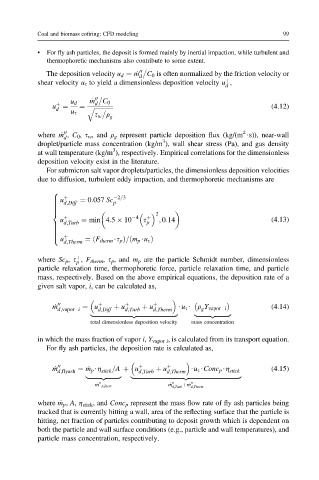
              The deposition velocity u d ¼ _ m 00 d  C 0 is often normalized by the friction velocity or
                                                              þ
           shear velocity u s to yield a dimensionless deposition velocity u ,
                                                              d

                    u d   _ m 00 d  C 0
                þ
               u ¼         ffiffiffiffiffiffiffiffiffiffiffiffi                                   (4.12)
                d     ¼ q
                    u s
                           s w r g
                                                                   2
           where _ m , C 0 , s w , and r g represent particle deposition flux (kg/(m $s)), near-wall
                  00
                  d
                                             3
           droplet/particle mass concentration (kg/m ), wall shear stress (Pa), and gas density
                               3
           at wall temperature (kg/m ), respectively. Empirical correlations for the dimensionless
           deposition velocity exist in the literature.
              For submicron salt vapor droplets/particles, the dimensionless deposition velocities
           due to diffusion, turbulent eddy impaction, and thermophoretic mechanisms are
               8
               > u     ¼ 0:057 Sc  2=3
               > þ
               > d;Diff         p
               >
               >
               >
               <                            2
                 u þ   ¼ min 4:5   10  4  s þ  ; 0:14                     (4.13)
                  d;Turb                 p
               >
               >
               >
               >
               >
               > þ
               : u      ¼ðF therm $s p Þ=ðm p $u s Þ
                  d;Therm
           where Sc p , s , F therm , s p , and m p are the particle Schmidt number, dimensionless
                      þ
                      p
           particle relaxation time, thermophoretic force, particle relaxation time, and particle
           mass, respectively. Based on the above empirical equations, the deposition rate of a
           given salt vapor, i, can be calculated as,


                _ m 00  ¼ u þ   þ u þ  þ u þ                              (4.14)
                                                       g
                 d;vapor i  d;Diff  d;Turb  d;Therm  $u s $ r Y vapor i
                         |fflfflfflfflfflfflfflfflfflfflfflfflfflfflfflfflfflfflfflfflfflfflfflfflffl{zfflfflfflfflfflfflfflfflfflfflfflfflfflfflfflfflfflfflfflfflfflfflfflfflffl}  |fflfflfflfflfflfflfflffl{zfflfflfflfflfflfflfflffl}
                         total dimensionless deposition velocity  mass concentration
           in which the mass fraction of vapor i, Y vapor i , is calculated from its transport equation.
              For fly ash particles, the deposition rate is calculated as,

                _ m 00 d;flyash  ¼ _ m p $h stick =A þ u þ  þ u þ  $u s $Conc p $h stick  (4.15)
                                              d;Therm
                                      d;Turb
                        |fflfflfflfflfflfflfflffl{zfflfflfflfflfflfflfflffl}  |fflfflfflfflfflfflfflfflfflfflfflfflfflfflfflfflfflfflfflfflfflfflfflfflfflfflfflfflfflfflfflffl{zfflfflfflfflfflfflfflfflfflfflfflfflfflfflfflfflfflfflfflfflfflfflfflfflfflfflfflfflfflfflfflffl}
                            00                 _ m 00  þ _ m 00
                           _ m d;Inert          d;Turb  d;Therm
           where _ m p , A, h stick , and Conc p represent the mass flow rate of fly ash particles being
           tracked that is currently hitting a wall, area of the reflecting surface that the particle is
           hitting, net fraction of particles contributing to deposit growth which is dependent on
           both the particle and wall surface conditions (e.g., particle and wall temperatures), and
           particle mass concentration, respectively.

