


Page 131 - New Trends In Coal Conversion
P. 131
94                                             New Trends in Coal Conversion

         4.3.4  Heterogeneous reactions

         When travelling through gas and interacting with gas in the furnace, the fuel particles
         heat up and undergo a series of heterogeneous reactions such as pyrolysis and char
         oxidation and gasification, creating sources for reactions in the gas phase.


         4.3.4.1  Pyrolysis
         Pyrolysis, occurring at the early stage of solid fuel combustion, plays a key role in a
         combustion process. It controls the yields of volatiles, tars, and char; determines the
         split of fuel nitrogen into volatiles and char; and affects the physical properties of
         the resultant char. Therefore, ignition, flame stability, char burnout, and pollutant for-
         mation are all affected. Proper modeling of the pyrolysis process is important in cofir-
         ing CFD. As reviewed in (Yu et al., 2007), there are different pyrolysis models, e.g., as
         follows:
         •  the single kinetic rate model, assuming the pyrolysis rate is first-order dependent on the
            amount of volatiles left in the particle (Badzioch and Hawksley, 1970),
         •  the two competing rates model, in which two different kinetic rates control the pyrolysis over
            different temperature ranges (Kobayashi et al., 1976),
         •  various network pyrolysis models, which do not rely on Arrhenius rate relations; e.g., the
            chemical percolation devolatilization model (Grant et al., 1989), the functional groupd
            depolymerization, vaporization, cross-linking model (Solomon et al., 1988), and the
            FLASHCHAIN model (Niksa and Kerstein, 1991).
            Among these models, the most commonly used model is still the single kinetic rate
         model. Because of the lack of data, the Arrhenius rate parameters are often taken from
         the literature. They are better determined experimentally or even estimated by network
         pyrolysis codes because the pyrolysis kinetic data are dependent on the fuel properties
         and pyrolysis conditions and the literature data are not likely to be general.


         4.3.4.2  Char reactions

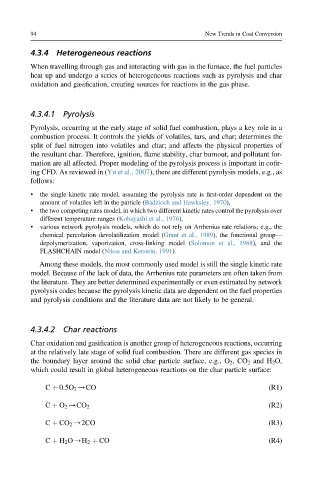
         Char oxidation and gasification is another group of heterogeneous reactions, occurring
         at the relatively late stage of solid fuel combustion. There are different gas species in
         the boundary layer around the solid char particle surface, e.g., O 2 ,CO 2 and H 2 O,
         which could result in global heterogeneous reactions on the char particle surface:

             C þ 0:5O 2 /CO                                               (R1)

                                                                          (R2)
             C þ O 2 /CO 2
             C þ CO 2 /2CO                                                (R3)

             C þ H 2 O/H 2 þ CO                                           (R4)

