


Page 129 - New Trends In Coal Conversion
P. 129
92                                             New Trends in Coal Conversion

         outperforms RANS simulation in terms of accuracy, at the expenses of computational
         efficiency.
            In a combustion furnace, turbulence plays the central role in mixing, and then in
         heat and mass transfer, as well as chemical reactions. Accurate modeling of turbulence
         is very important. From this point of view, one can expect an eventual switch from
         RANS turbulence modeling to LES even for industrial cofiring CFD.


         4.3.2  Fuel particle motion
         Correct prediction of fuel particle trajectory in a furnace is important for air supply and
         combustion performance. The particle tracking model most commonly used in CFD is
         for small, heavy particles in dilute two-phase flows, for which it is sufficient to only
         retain drag and gravity forces in the equation of motion of particles (Maxey and Riley,
         1983),

                    1
                dv
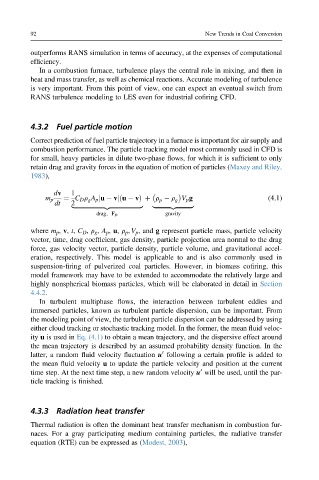
             m p  ¼ C D r A p ju   vjðu   vÞ þ r   r V p g               (4.1)
                                            p
                         g
                                                g
                dt  2
                    |fflfflfflfflfflfflfflfflfflfflfflfflfflfflfflfflfflfflfflffl{zfflfflfflfflfflfflfflfflfflfflfflfflfflfflfflfflfflfflfflffl}  |fflfflfflfflfflfflfflfflfflffl{zfflfflfflfflfflfflfflfflfflffl}
                                              gravity
                           drag; F D
         where m p , v, t, C D , r g , A p , u, r p , V p , and g represent particle mass, particle velocity
         vector, time, drag coefficient, gas density, particle projection area normal to the drag
         force, gas velocity vector, particle density, particle volume, and gravitational accel-
         eration, respectively. This model is applicable to and is also commonly used in
         suspension-firing of pulverized coal particles. However, in biomass cofiring, this
         model framework may have to be extended to accommodate the relatively large and
         highly nonspherical biomass particles, which will be elaborated in detail in Section
         4.4.2.
            In turbulent multiphase flows, the interaction between turbulent eddies and
         immersed particles, known as turbulent particle dispersion, can be important. From
         the modeling point of view, the turbulent particle dispersion can be addressed by using
         either cloud tracking or stochastic tracking model. In the former, the mean fluid veloc-
         ity u is used in Eq. (4.1) to obtain a mean trajectory, and the dispersive effect around
         the mean trajectory is described by an assumed probability density function. In the
         latter, a random fluid velocity fluctuation u following a certain profile is added to
                                             0
         the mean fluid velocity u to update the particle velocity and position at the current
                                                       0
         time step. At the next time step, a new random velocity u will be used, until the par-
         ticle tracking is finished.


         4.3.3  Radiation heat transfer
         Thermal radiation is often the dominant heat transfer mechanism in combustion fur-
         naces. For a gray participating medium containing particles, the radiative transfer
         equation (RTE) can be expressed as (Modest, 2003),

