


Page 133 - New Trends In Coal Conversion
P. 133
96                                             New Trends in Coal Conversion

            For nonpremixed combustion, the thermochemistry can be reduced under certain
         assumptions to a single conserved parameter: the mixture fraction. The mixture frac-
         tion is the mass fraction of the elements that originate from the fuel stream. Because the
         mixture fraction is a conserved scalar, its governing transport equation does not have a
         source term, eliminating the difficulties associated with modeling the nonlinear mean
         reaction rates in the species transport equations. By using mixture fraction approach
         for nonpremixed combustion, combustion is simplified to a mixing problem. Once
         mixed, the instantaneous species fractions, density, and temperatures can be related
         to the calculated mixture fractions by using detailed kinetic mechanisms, e.g., the equi-
         librium model, steady diffusion flamelet model, or unsteady diffusion flamelet model.
         Then, the time-averaged values of the parameters such as species and temperature are
         evaluated from the instantaneous values and an assumed probability density function
         (PDF).


         4.3.6  Pollutant formation
         NO x in combustion processes can be formed via thermal NO x (by oxidation of N 2 in
         the oxidizer at temperatures above 1800 K), prompt NO x (by hydrocarbon radicals
         attacking N 2 to form cyanide species and then to NO at the flame front), and fuel
         NO x (by oxidation of nitrogen contained in the fuel). For conventional air-fuel com-
         bustion of pulverized coal, the majority of the total NO x is from fuel NO x and up to
         20% is due to thermal NO x , while the prompt NO x is negligible (Glarborg et al., 2003).


         4.3.6.1  Thermal NO x
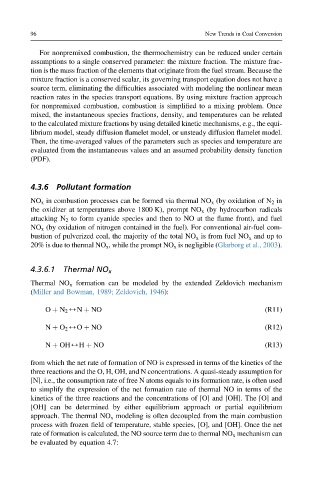
         Thermal NO x formation can be modeled by the extended Zeldovich mechanism
         (Miller and Bowman, 1989; Zeldovich, 1946):

             O þ N 2 4N þ NO                                             (R11)

             N þ O 2 4O þ NO                                             (R12)

             N þ OH4H þ NO                                               (R13)

         from which the net rate of formation of NO is expressed in terms of the kinetics of the
         three reactions and the O, H, OH, and N concentrations. A quasi-steady assumption for
         [N], i.e., the consumption rate of free N atoms equals to its formation rate, is often used
         to simplify the expression of the net formation rate of thermal NO in terms of the
         kinetics of the three reactions and the concentrations of [O] and [OH]. The [O] and
         [OH] can be determined by either equilibrium approach or partial equilibrium
         approach. The thermal NO x modeling is often decoupled from the main combustion
         process with frozen field of temperature, stable species, [O], and [OH]. Once the net
         rate of formation is calculated, the NO source term due to thermal NO x mechanism can
         be evaluated by equation 4.7:

