


Page 135 - New Trends In Coal Conversion
P. 135
98                                             New Trends in Coal Conversion


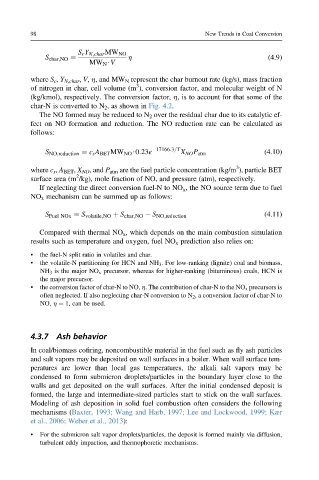
                      S c Y N;char MW NO
             S char;NO ¼            h                                    (4.9)
                         MW N $V
         where S c , Y N,char , V, h, and MW N represent the char burnout rate (kg/s), mass fraction
                                      3
         of nitrogen in char, cell volume (m ), conversion factor, and molecular weight of N
         (kg/kmol), respectively. The conversion factor, h, is to account for that some of the
         char-N is converted to N 2 , as shown in Fig. 4.2.
            The NO formed may be reduced to N 2 over the residual char due to its catalytic ef-
         fect on NO formation and reduction. The NO reduction rate can be calculated as
         follows:

             S NO;reduction ¼ c s A BET MW NO $0:23e  17166:3=T  X NO P atm  (4.10)

                                                                 3
         where c s , A BET , X NO , and P atm are the fuel particle concentration (kg/m ), particle BET
                      2
         surface area (m /kg), mole fraction of NO, and pressure (atm), respectively.
            If neglecting the direct conversion fuel-N to NO x , the NO source term due to fuel
         NO x mechanism can be summed up as follows:

             S Fuel NOx ¼ S volatile;NO þ S char;NO   S NO;reduction    (4.11)

            Compared with thermal NO x , which depends on the main combustion simulation
         results such as temperature and oxygen, fuel NO x prediction also relies on:
         •  the fuel-N split ratio in volatiles and char.
         •  the volatile-N partitioning for HCN and NH 3 . For low-ranking (lignite) coal and biomass,
            NH 3 is the major NO x precursor, whereas for higher-ranking (bituminous) coals, HCN is
            the major precursor.
         •  the conversion factor of char-N to NO, h. The contribution of char-N to the NO x precursors is
            often neglected. If also neglecting char-N conversion to N 2 , a conversion factor of char-N to
            NO, h ¼ 1, can be used.


         4.3.7  Ash behavior

         In coal/biomass cofiring, noncombustible material in the fuel such as fly ash particles
         and salt vapors may be deposited on wall surfaces in a boiler. When wall surface tem-
         peratures are lower than local gas temperatures, the alkali salt vapors may be
         condensed to form submicron droplets/particles in the boundary layer close to the
         walls and get deposited on the wall surfaces. After the initial condensed deposit is
         formed, the large and intermediate-sized particles start to stick on the wall surfaces.
         Modeling of ash deposition in solid fuel combustion often considers the following
         mechanisms (Baxter, 1993; Wang and Harb, 1997; Lee and Lockwood, 1999; Kær
         et al., 2006; Weber et al., 2013):
         •  For the submicron salt vapor droplets/particles, the deposit is formed mainly via diffusion,
            turbulent eddy impaction, and thermophoretic mechanisms.

