


Page 130 - New Trends In Coal Conversion
P. 130
Coal and biomass cofiring: CFD modeling                             93

                                           4
               dI     sT g 4  X         sT p;i
                 ¼ a        þ    ε p;i n i A p;i     ða þ a p þ s p ÞI
               ds      p                  p
                     |fflffl{zfflffl}  i                 |fflfflfflfflfflfflfflfflfflfflffl{zfflfflfflfflfflfflfflfflfflfflffl}
                    gas emission  |fflfflfflfflfflfflfflfflfflfflfflfflfflffl{zfflfflfflfflfflfflfflfflfflfflfflfflfflffl}  absorption=scattering losses
                                particle emission
                         Z
                      s p      0
                    þ      4 b s 0b s IdU 0                                (4.2)
                      4p  4p
                      |fflfflfflfflfflfflfflfflfflfflfflfflfflfflfflfflfflfflffl{zfflfflfflfflfflfflfflfflfflfflfflfflfflfflfflfflfflfflffl}
                          in scattering gain
                      !                                         0
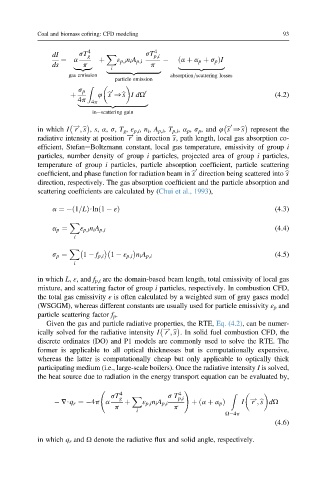
           in which I r ;b s , s, a, s, T g , ε p,i , n i , A p,i , T p,i , a p , s p , and 4 b s 0b s represent the
                                   !
           radiative intensity at position r in direction b s, path length, local gas absorption co-
           efficient, StefaneBoltzmann constant, local gas temperature, emissivity of group i
           particles, number density of group i particles, projected area of group i particles,
           temperature of group i particles, particle absorption coefficient, particle scattering
                                                      0
           coefficient, and phase function for radiation beam in b s direction being scattered into b s
           direction, respectively. The gas absorption coefficient and the particle absorption and
           scattering coefficients are calculated by (Chui et al., 1993),

               a ¼ ð1=LÞ$lnð1   εÞ                                         (4.3)

                    X
               a p ¼   ε p;i n i A p;i                                     (4.4)
                     i
                    X
               s p ¼   1   f p;i 1   ε p;i n i A p;i                       (4.5)
                     i

           in which L, ε, and f p,i are the domain-based beam length, total emissivity of local gas
           mixture, and scattering factor of group i particles, respectively. In combustion CFD,
           the total gas emissivity ε is often calculated by a weighted sum of gray gases model
           (WSGGM), whereas different constants are usually used for particle emissivity ε p and
           particle scattering factor f p .
              Given the gas and particle radiative properties, the RTE, Eq. (4.2), can be numer-
                                              !
           ically solved for the radiative intensity I r ;b s . In solid fuel combustion CFD, the
           discrete ordinates (DO) and P1 models are commonly used to solve the RTE. The
           former is applicable to all optical thicknesses but is computationally expensive,
           whereas the latter is computationally cheap but only applicable to optically thick
           participating medium (i.e., large-scale boilers). Once the radiative intensity I is solved,
           the heat source due to radiation in the energy transport equation can be evaluated by,

                                                   !
                               sT g 4  X      s T 4 p;i        Z
                                                                     r ;b s dU
                  V$q r ¼ 4p a     þ    ε p;i n i A p;i  þ ða þ a p Þ  I  !
                                p               p
                                      i
                                                              U¼4p
                                                                           (4.6)
           in which q r and U denote the radiative flux and solid angle, respectively.

