


Page 320 - Numerical Analysis Using MATLAB and Excel
P. 320
Chapter 7  Finite Differences and Interpolation


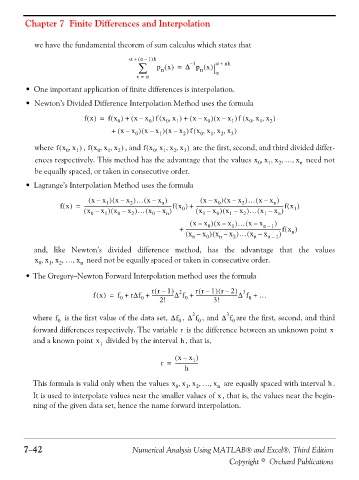
                   we have the fundamental theorem of sum calculus which states that

                                                      )
                                               α +  (  n –  1 h  –       α +
                                                  ∑    p x() =  Δ p x()     nh
                                                                  1
                                                         n
                                                                    n
                                                 x =  α                  α
                • One important application of finite differences is interpolation.
                • Newton’s Divided Difference Interpolation Method uses the formula

                                 fx() =  fx ) (  0  +  (  xx )  –  0  fx x ) (  0 ,  1  +  (  x –  x )  0  (  xx )  –  1  fx x x ) (  0 ,  1 ,  2
                                          xx )+  (  –  0  (  x – x )  1  (  x –  x )  2  fx x x x ) (  0 ,  1 ,  2 ,  3

                   where fx x,(  0  1 )  , fx x x,(  0  1 ,  2 )  , and fx x x x,(  0  1 ,  2 ,  3 )   are the first, second, and third divided differ-

                   ences respectively. This method has the advantage that the values x x x … x,  0  1 ,  2 ,  ,  n  need not
                   be equally spaced, or taken in consecutive order.
                • Lagrange’s Interpolation Method uses the formula

                                   (  x –  x )  (  xx )  –  …  (  x –  x )  (  xx )  –  (  x – x )  …  (  xx )  –
                                        1
                                                                                 2
                                               2
                                                                                          n
                                                         n
                                                                          0
                          fx() =  ------------------------------------------------------------------------fx (  )  +  ------------------------------------------------------------------------fx (  )
                                 (  x – x )  1  (  x –  x )  2  …  (  x –  x )  n  0  (  x – x )  0  (  x –  x )  2  …  (  x –  x )  n  1
                                                      0
                                                                     1
                                                                                        1
                                                                             1
                                   0
                                            0
                                                                 (  x –  x )  (  xx )  –  …  (  x –  x  )
                                                                                       n –
                                                                              1
                                                                                          1
                                                                       0
                                                               +  ------------------------------------------------------------------------------fx (  )
                                                                (  x –  x )  0  (  x –  x )  2  …  (  x –  x n –  1 )  n
                                                                                    n
                                                                          n
                                                                  n
                  and, like Newton’s divided difference  method, has the advantage that the values
                   x x x … x,  0  1 ,  2 ,  ,  n  need not be equally spaced or taken in consecutive order.
                •The Gregory−Newton Forward Interpolation method uses the formula
                                                                          (
                                                       (
                                                                    (
                                                                         )
                                                      rr –  1 )  2  rr –  1 r –  2 )  3
                                    fx() =  f +  rΔf +  ------------------Δ f +  ----------------------------------Δ f + …
                                                                                   0
                                            0
                                                   0
                                                                0
                                                        2!
                                                                        3!
                                                                  2         3
                         f
                  where   is the first value of the data set,  Δf 0  ,  Δ f 0  , and  Δ f 0 are the first, second, and third
                          0
                                                              r
                  forward differences respectively. The variable   is the difference between an unknown point x
                  and a known point x 1  divided by the interval  , that is,
                                                              h
                                                             (  x –  x )
                                                                  1
                                                         r =  -------------------
                                                                h
                  This formula is valid only when the values x x x … x,  0  1 ,  2 ,  ,  n  are equally spaced with interval  . h
                  It is used to interpolate values near the smaller values of  , that is, the values near the begin-
                                                                          x
                  ning of the given data set, hence the name forward interpolation.
               7−42                             Numerical Analysis Using MATLAB® and Excel®, Third Edition
                                                                             Copyright © Orchard Publications

