


Page 318 - Numerical Analysis Using MATLAB and Excel
P. 318
Chapter 7  Finite Differences and Interpolation


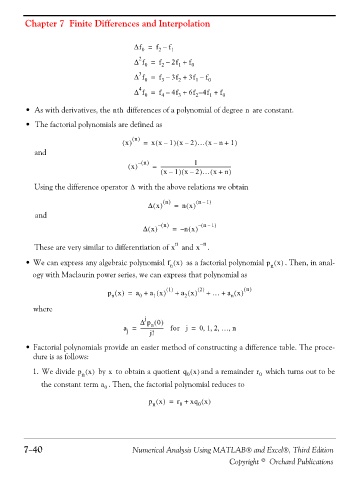
                                                 Δf =  f – f 1
                                                   0
                                                        2
                                                  2
                                                 Δ f =  f –  2f +  f 0
                                                         2
                                                    0
                                                              1
                                                  3
                                                 Δ f =  f –  3f +  3f –  f 0
                                                         3
                                                              2
                                                    0
                                                                   1
                                                  4
                                                 Δ f =  f –  4f +  6f – 4f +  f 0
                                                                   2
                                                                       1
                                                              3
                                                    0
                                                         4
                • As with derivatives, the nth  differences of a polynomial of degree  are constant.
                                                                                  n
                • The factorial polynomials are defined as
                                              x ()  n ()  xx 1 x2 …  –  )  (  x –  n + 1 )
                                                             (
                                                            )
                                                         –
                                                       ( =
                   and
                                                                  1
                                                x () –  n ()  =  ----------------------------------------------------------
                                                        (  x –  1 x –  2 …  )  (  x + n )
                                                              )
                                                               (
                   Using the difference operator   with the above relations we obtain
                                               Δ
                                                                     –
                                                     Δ x()  n ()  =  nx() (  n 1 )
                   and
                                                   Δ x() –  n ()  =  – n x()  (  n –  1 ) –
                                                             n      – n
                   These are very similar to differentiation of x   and x  .
                • We can express any algebraic polynomial f x()   as a factorial polynomial p x() . Then, in anal-
                                                                                         n
                                                           n
                  ogy with Maclaurin power series, we can express that polynomial as
                                         p x() =  a +  a x()  1 ()  +  a x()  2 ()  +  … + a x()  n ()
                                                  0
                                                                2
                                          n
                                                      1
                                                                              n
                  where
                                                    j
                                                  Δ p 0()
                                                      n
                                                                     ,,,
                                                                             ,
                                             a =  -------------------   for   j =  0 1 2 … n
                                              j
                                                     j!
                • Factorial polynomials provide an easier method of constructing a difference table. The proce-
                  dure is as follows:
                  1. We divide p x()  by   to obtain a quotient q x() and a remainder   which turns out to be
                                                                                     r
                                         x
                                                                                      0
                                 n
                                                                0
                     the constant term a 0 . Then, the factorial polynomial reduces to
                                                     p x() =  r +  xq x()
                                                      n
                                                              0
                                                                    0
               7−40                             Numerical Analysis Using MATLAB® and Excel®, Third Edition
                                                                             Copyright © Orchard Publications

