


Page 285 - PRINCIPLES OF QUANTUM MECHANICS as Applied to Chemistry and Chemical Physics
P. 285
276 Molecular structure
1
W n (n )"ù, n 0, 1, 2, ...
2
where
p
ù k=ì
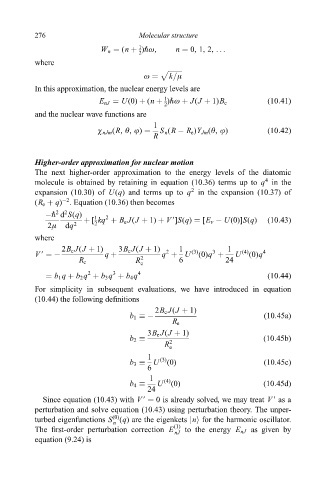
In this approximation, the nuclear energy levels are
1
E nJ U(0) (n )"ù J(J 1)B e (10:41)
2
and the nuclear wave functions are
1
÷ nJm (R, è, j) S n (R ÿ R e )Y Jm (è, j) (10:42)
R
Higher-order approximation for nuclear motion
The next higher-order approximation to the energy levels of the diatomic
4
molecule is obtained by retaining in equation (10.36) terms up to q in the
2
expansion (10.30) of U(q) and terms up to q in the expansion (10.37) of
ÿ2
(R e q) . Equation (10.36) then becomes
2
2
ÿ" d S(q) 2
1
[ kq B e J(J 1) V9]S(q) [E í ÿ U(0)]S(q) (10:43)
2ì dq 2 2
where
2B e J(J 1) 3B e J(J 1) 2 1 (3) 3 1 (4) 4
V9 ÿ q 2 q U (0)q U (0)q
R e R 6 24
e
2
3
b 1 q b 2 q b 3 q b 4 q 4 (10:44)
For simplicity in subsequent evaluations, we have introduced in equation
(10.44) the following de®nitions
2B e J(J 1)
b 1 ÿ (10:45a)
R e
3B e J(J 1)
b 2 2 (10:45b)
R e
1
(3)
b 3 U (0) (10:45c)
6
1
(4)
b 4 U (0) (10:45d)
24
Since equation (10.43) with V9 0 is already solved, we may treat V9 as a
perturbation and solve equation (10.43) using perturbation theory. The unper-
(0)
turbed eigenfunctions S (q) are the eigenkets jni for the harmonic oscillator.
n
The ®rst-order perturbation correction E (1) to the energy E nJ as given by
nJ
equation (9.24) is

