


Page 286 - PRINCIPLES OF QUANTUM MECHANICS as Applied to Chemistry and Chemical Physics
P. 286
10.2 Nuclear motion in diatomic molecules 277
3
2
4
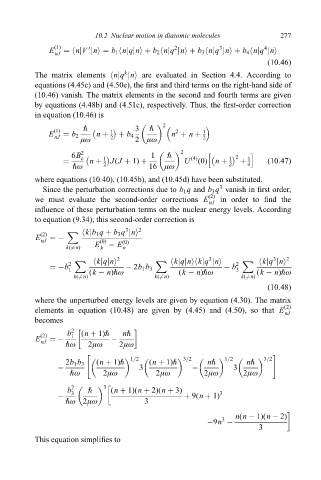
E (1) hnjV9jni b 1 hnjqjni b 2 hnjq jni b 3 hnjq jni b 4 hnjq jni
nJ
(10:46)
k
The matrix elements hnjq jni are evaluated in Section 4.4. According to
equations (4.45c) and (4.50e), the ®rst and third terms on the right-hand side of
(10.46) vanish. The matrix elements in the second and fourth terms are given
by equations (4.48b) and (4.51c), respectively. Thus, the ®rst-order correction
in equation (10.46) is
2
(1) " ÿ 1 3 " 2 1
E nJ b 2 ìù n 2 b 4 2 ìù n n 2
2 2 h i
6B ÿ 1 1 " (4) ÿ 1 2 1
e
n J(J 1) U (0) n (10:47)
"ù 2 16 ìù 2 4
where equations (10.40), (10.45b), and (10.45d) have been substituted.
3
Since the perturbation corrections due to b 1 q and b 3 q vanish in ®rst order,
we must evaluate the second-order corrections E (2) in order to ®nd the
nJ
in¯uence of these perturbation terms on the nuclear energy levels. According
to equation (9.34), this second-order correction is
3 2
X hkjb 1 q b 3 q jni
(2)
E ÿ
nJ (0) (0)
k(6n) E k ÿ E n
2 3 3 2
X hkjqjni X hkjqjnihkjq jni 2 X hkjq jni
2
ÿb ÿ 2b 1 b 3 ÿ b
1 (k ÿ n)"ù (k ÿ n)"ù 3 (k ÿ n)"ù
k(6n) k(6n) k(6n)
(10:48)
where the unperturbed energy levels are given by equation (4.30). The matrix
(2)
elements in equation (10.48) are given by (4.45) and (4.50), so that E nJ
becomes
b 2 (n 1)" n"
(2) 1
E nJ ÿ "ù 2ìù ÿ 2ìù
" #
1=2 3=2 1=2 3=2
2b 1 b 3 (n 1)" (n 1)" n" n"
ÿ 3 ÿ 3
"ù 2ìù 2ìù 2ìù 2ìù
3
b 2 " (n 1)(n 2)(n 3)
ÿ 3 9(n 1) 3
"ù 2ìù 3
n(n ÿ 1)(n ÿ 2)
3
ÿ9n ÿ
3
This equation simpli®es to

