


Page 156 - Partition & Adsorption of Organic Contaminants in Environmental Systems
P. 156
SORPTION FROM WATER SOLUTION     147

            in soil with time, it must be relatively refractory and insoluble in water, such
            as petroleum hydrocarbons, PCB oils, coal tars, and some chlorinated solvents.
              When a separate organic phase exists in a soil, the sorption of a contami-
            nant from water into this soil consists of a concurrent partition into SOM and
            into the exotic organic phase. In their treatment of contaminant sorption to
            soils contaminated by a PCB oil, Sun and Boyd (1991) expressed the appar-
            ent contaminant sorption coefficient (K*) as
                                               d
                                                                          (7.20)
                               K* = f omK om + f oilK oil = K d + f oilK oil
                                 d
            where f om, K om, and K d are as defined previously, f oil the mass fraction of the
            oil in soil, and K oil the contaminant partition coefficient between the oil and
            water. Note that in Eq. (7.20), f oil accounts in principle only for the oil content
            that exists as a separate phase, not including the mass partitioned into SOM,
            as described below. It may be safely assumed that the small amount of oil
            partitioned into SOM does not significantly alter the medium properties of
            the SOM.
              Since K oil is expected to be orders of magnitude greater than K om for non-
            polar organic compounds, the K* value of a nonpolar contaminant with a soil
                                        d
            containing an excess oil phase will be greatly higher than K d if f oil is a sizable
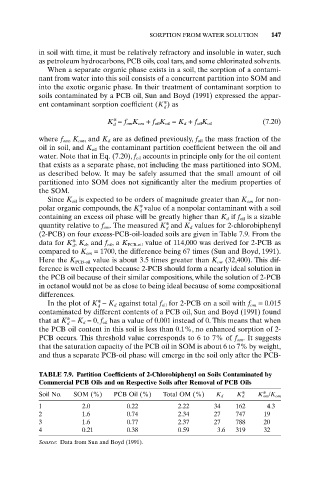
            quantity relative to f om. The measured K* and K d values for 2-chlorobiphenyl
                                               d
            (2-PCB) on four excess-PCB-oil-loaded soils are given in Table 7.9. From the
            data for K* , K d, and f oil,a K PCB-oil value of 114,000 was derived for 2-PCB as
                     d
            compared to K om = 1700, the difference being 67 times (Sun and Boyd, 1991).
            Here the K PCB-oil value is about 3.5 times greater than K ow (32,400). This dif-
            ference is well expected because 2-PCB should form a nearly ideal solution in
            the PCB oil because of their similar compositions, while the solution of 2-PCB
            in octanol would not be as close to being ideal because of some compositional
            differences.
              In the plot of K* - K d against total f oil for 2-PCB on a soil with f om = 0.015
                            d
            contaminated by different contents of a PCB oil, Sun and Boyd (1991) found
            that at K* - K d = 0, f oil has a value of 0.001 instead of 0. This means that when
                    d
            the PCB oil content in this soil is less than 0.1%, no enhanced sorption of 2-
            PCB occurs. This threshold value corresponds to 6 to 7% of f om. It suggests
            that the saturation capacity of the PCB oil in SOM is about 6 to 7% by weight,
            and thus a separate PCB-oil phase will emerge in the soil only after the PCB-

            TABLE 7.9. Partition Coefficients of 2-Chlorobiphenyl on Soils Contaminated by
            Commercial PCB Oils and on Respective Soils after Removal of PCB Oils
            Soil No.  SOM (%)    PCB Oil (%)  Total OM (%)   K d   K* d  K* /K om
                                                                          om
            1           2.0         0.22          2.22      34    162      4.3
            2           1.6         0.74          2.34      27    747     19
            3           1.6         0.77          2.37      27    788     20
            4           0.21        0.38          0.59       3.6  319     32
            Source: Data from Sun and Boyd (1991).

