


Page 159 - Partition & Adsorption of Organic Contaminants in Environmental Systems
P. 159
150   CONTAMINANT SORPTION TO SOILS AND NATURAL SOLIDS

           the linear partition to SOM (Chiou, 1995; Gustafsson et al., 1997; Chiou et al.,
           1998); (3) the availability of compound-specific “internal holes” (or internal
           pores) in SOM for adsorption of specific solutes in addition to solute partition
           into the water-saturated SOM (Pignatello and Xing, 1996; Xing et al., 1996;
           Xing and Pignatello, 1997); and (4) the occurrence of specific interactions for
           polar solutes with limited active sites in SOM in addition to solute partition
           to SOM, the former effect approaching saturation at lower solute concentra-
           tions (Spurlock and Biggars, 1994). Some pertinent experimental data are pre-
           sented below to give readers a brief overview of the problem involved.
              The sorption data on some reference samples (a soil, peat, and soil humic
           acid) from Xing et al. (1996) indicate that the nonlinear sorption tends to be
           more pronounced for polar solutes (e.g., atrazine and prometon) than for low-
           polarity solutes (e.g., TCE), the data being based on their Freundlich (or log-
           log) plots. On the Cheshire fine sandy loam used by Xing et al. (1996), TCE
           exhibits essentially no nonlinearity, with concentrations ranging from
                        -4
                                                  -1
           <0.1mg/L (<10 in C e/S w) to >100mg/L (>10 in C e/S w). By comparison, the
           sorption of phenanthrene on some soils and shales reported by Young and
           Weber (1995) exhibits significant nonlinearity at low concentrations. It thus
           appears that the extent of nonlinear sorption for nonpolar solutes tends to
           depend on the soil source and to be smaller in magnitude relative to that for
           polar solutes. In addition, Xing et al. (1996) noted that in the binary-solute
           systems a coexisting polar solute (prometon) strongly suppresses the non-
           linear sorption of the nominal polar solute (atrazine), whereas a coexisting
           nonpolar solute (TCE) exerts only a small suppressing effect. To account for
           these observations, Xing et al. (1996) proposed that different sets of
           compound-specific internal holes exist in SOM for adsorption of different
           compounds in addition to their conventional partition into bulk SOM.
              To contemplate on the sources of sorption nonlinearity, Chiou and Kile
           (1998) presented extensive sorption data utilizing several polar and nonpolar
           compounds on a peat (organic) soil and a mineral soil. The compounds studied
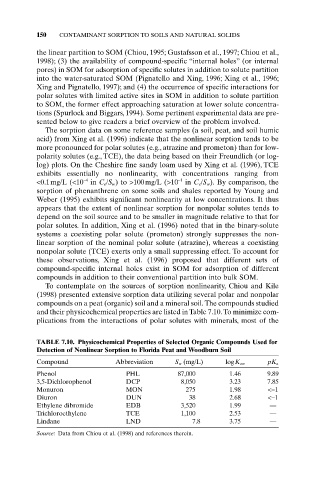
           and their physicochemical properties are listed in Table 7.10.To minimize com-
           plications from the interactions of polar solutes with minerals, most of the


           TABLE 7.10. Physicochemical Properties of Selected Organic Compounds Used for
           Detection of Nonlinear Sorption to Florida Peat and Woodburn Soil
           Compound              Abbreviation     S w (mg/L)    logK ow    pK a
           Phenol                   PHL           87,000         1.46      9.89
           3,5-Dichlorophenol       DCP            8,050         3.23      7.85
           Monuron                  MON              275         1.98      <-1
           Diuron                   DUN               38         2.68      <-1
           Ethylene dibromide       EDB            3,520         1.99       —
           Trichloroethylene        TCE            1,100         2.53       —
           Lindane                  LND               7.8        3.75       —
           Source: Data from Chiou et al. (1998) and references therein.

