


Page 160 - Partition & Adsorption of Organic Contaminants in Environmental Systems
P. 160
SORPTION FROM WATER SOLUTION     151

            sorption data were obtained on the peat soil ( f oc = 0.493), with supplemental
            data on a mineral (Woodburn) soil (f oc = 0.0126). Polar solutes from two chem-
            ical classes (phenols and substituted ureas) and three low-polarity solutes (eth-
            ylene dibromide, TCE, and lindane) were employed in sorption experiments.
            In addition to single-solute isotherms, the isotherms of nominal solutes in
            many binary-solute mixtures were also determined, with the competing solutes
            (co-solutes) taken from either the same class or from a different class. Binary-
            solute sorption studies examine the competitive sorption of polar solutes both
            between and within chemical classes, considering that the earlier binary-solute
            studies were confined mainly to solutes from the same or similar class (Xing
            et al., 1996). Results on solute competition are critical to assessing the effect
            of various co-solutes on the behavior of a given solute (contaminant) in mul-
            tisolute natural systems. A comparison of single-solute and binary-solute
            isotherms enables one to separate the relative effects of linear partition to
            SOM and nonlinear sorption to soil.
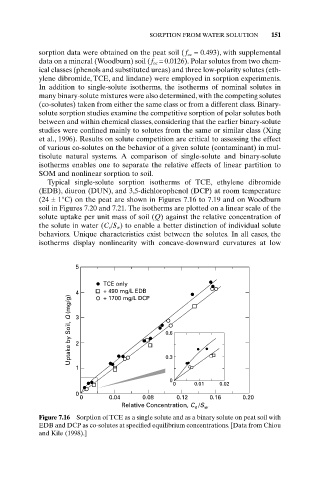
              Typical single-solute sorption isotherms of  TCE, ethylene dibromide
            (EDB), diuron (DUN), and 3,5-dichlorophenol (DCP) at room temperature
            (24 ± 1°C) on the peat are shown in Figures 7.16 to 7.19 and on Woodburn
            soil in Figures 7.20 and 7.21. The isotherms are plotted on a linear scale of the
            solute uptake per unit mass of soil (Q) against the relative concentration of
            the solute in water (C e /S w ) to enable a better distinction of individual solute
            behaviors. Unique characteristics exist between the solutes. In all cases, the
            isotherms display nonlinearity with concave-downward curvatures at low


                      5

                              TCE only
                              + 490 mg/L EDB
                    Uptake by Soil, Q   (mg/g) 4  0.6
                              + 1700 mg/L DCP

                      3


                      2


                      1                        0.3

                                                0
                                                 0     0.01   0.02
                      0
                       0       0.04      0.08     0.12     0.16     0.20
                                   Relative Concentration, C /S w
                                                       e
            Figure 7.16 Sorption of TCE as a single solute and as a binary solute on peat soil with
            EDB and DCP as co-solutes at specified equilibrium concentrations. [Data from Chiou
            and Kile (1998).]

