


Page 163 - Partition & Adsorption of Organic Contaminants in Environmental Systems
P. 163
154   CONTAMINANT SORPTION TO SOILS AND NATURAL SOLIDS

                      3


                    Uptake by Soil, Q   (mg/g)  2


                      1
                                                   DCP only
                                                   + 6000 mg/L PHL
                                                   + 12000 mg/L PHL


                      0
                       0          0.1        0.2         0.3         0.4
                                   Relative Concentration, C /S w
                                                       e
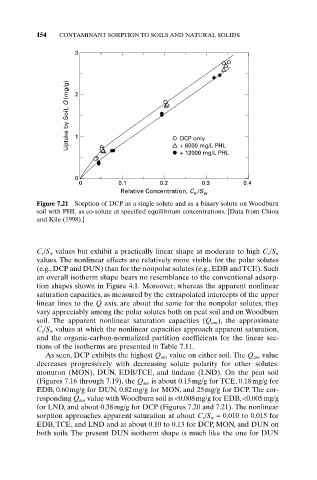
           Figure 7.21 Sorption of DCP as a single solute and as a binary solute on Woodburn
           soil with PHL as co-solute at specified equilibrium concentrations. [Data from Chiou
           and Kile (1998).]


           C e/S w values but exhibit a practically linear shape at moderate to high C e/S w
           values. The nonlinear effects are relatively more visible for the polar solutes
           (e.g., DCP and DUN) than for the nonpolar solutes (e.g., EDB and TCE). Such
           an overall isotherm shape bears no resemblance to the conventional adsorp-
           tion shapes shown in Figure 4.1. Moreover, whereas the apparent nonlinear
           saturation capacities, as measured by the extrapolated intercepts of the upper
           linear lines to the Q axis, are about the same for the nonpolar solutes, they
           vary appreciably among the polar solutes both on peat soil and on Woodburn
           soil. The apparent nonlinear saturation capacities (Q ans ), the approximate
           C e /S w values at which the nonlinear capacities approach apparent saturation,
           and the organic-carbon-normalized partition coefficients for the linear sec-
           tions of the isotherms are presented in Table 7.11.
              As seen, DCP exhibits the highest Q ans value on either soil. The Q ans value
           decreases progressively with decreasing solute polarity for other solutes:
           monuron (MON), DUN, EDB/TCE, and lindane (LND). On the peat soil
           (Figures 7.16 through 7.19), the Q ans is about 0.15mg/g for TCE, 0.18mg/g for
           EDB, 0.60mg/g for DUN, 0.82mg/g for MON, and 25mg/g for DCP. The cor-
           responding Q ans value with Woodburn soil is <0.008mg/g for EDB, <0.005mg/g
           for LND, and about 0.38mg/g for DCP (Figures 7.20 and 7.21). The nonlinear
           sorption approaches apparent saturation at about C e/S w = 0.010 to 0.015 for
           EDB, TCE, and LND and at about 0.10 to 0.13 for DCP, MON, and DUN on
           both soils. The present DUN isotherm shape is much like the one for DUN

