


Page 168 - Partition & Adsorption of Organic Contaminants in Environmental Systems
P. 168
SORPTION FROM WATER SOLUTION     159

            nation of the specific-interaction model of Spurlock and Biggar (1994) for
            polar solutes and the HSACM model for nonpolar solutes reconcile the out-
            standing features of the nonlinear and competitive sorption of the solutes with
            certain soil samples.
              Other substantial supporting evidence for the HSACM model emerged
            soon after the work of Chiou and Kile (1998). Kleineidam et al. (1999) used
            a petrographic method to identify charcoal-like particles in natural solids
            (limestone) and showed that the low-concentration sorption isotherm of a
            contaminant (phenanthrene) exhibits the greatest nonlinear sorption on solids
            that contain the highest amount of charcoal particles and reworked vitrinite.
            The mineral matter of these geosorbents contributed little to phenanthrene
            uptake, as expected, because of the adsorptive suppression by water.
            Karapanagioti et al. (2000) used the same method to identify similar charcoal-
            like particles in alluvial sediments. Karapanagioti et al. (2001) also achieved
            an independent confirmation of the charcoal-like substances in the (Florida)
            peat and Woodburn soil samples employed earlier by Chiou and Kile (1998).
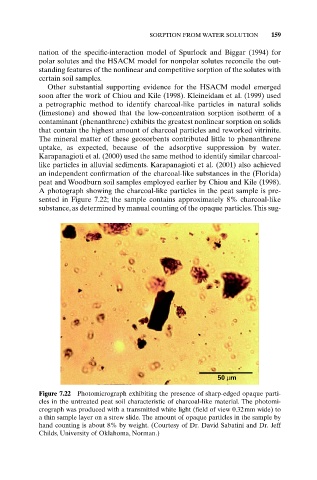
            A photograph showing the charcoal-like particles in the peat sample is pre-
            sented in Figure 7.22; the sample contains approximately 8% charcoal-like
            substance, as determined by manual counting of the opaque particles. This sug-


                                                             50 µm

            Figure 7.22 Photomicrograph exhibiting the presence of sharp-edged opaque parti-
            cles in the untreated peat soil characteristic of charcoal-like material. The photomi-
            crograph was produced with a transmitted white light (field of view 0.32mm wide) to
            a thin sample layer on a strew slide. The amount of opaque particles in the sample by
            hand counting is about 8% by weight. (Courtesy of Dr. David Sabatini and Dr. Jeff
            Childs, University of Oklahoma, Norman.)

