


Page 170 - Partition & Adsorption of Organic Contaminants in Environmental Systems
P. 170
SORPTION FROM WATER SOLUTION     161

                        TABLE 7.12. BET-N 2 Surface Areas (SA) and
                        Percents of Organic Carbon (OC) of Peat and
                        Fractionated Organic Matters
                                                                2
                        Sample            OC (%)           SA (m /g)
                        Peat                49.3             1.4
                        Peat HA             47.3             0.16
                        Muck HA             46.3             0.17
                        HM                  51.4             4.5
                        Source: Data from Chiou et al. (2000).


                      20

                                 Peat HA
                    Uptake by Sorbent, Q   (mg/g)  10  2 1
                                 Muck HA
                      15


                      5


                                                   0
                                                    0     0.02   0.04
                      0
                        0             0.2             0.4            0.6
                                   Relative Concentration, C /S w
                                                       e
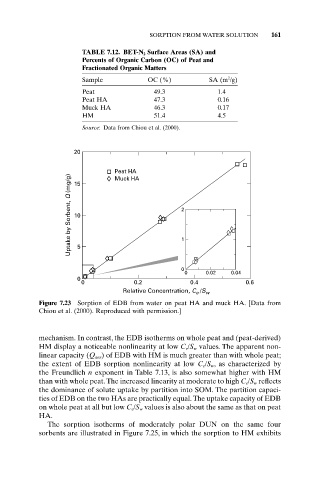
            Figure 7.23 Sorption of EDB from water on peat HA and muck HA. [Data from
            Chiou et al. (2000). Reproduced with permission.]


            mechanism. In contrast, the EDB isotherms on whole peat and (peat-derived)
            HM display a noticeable nonlinearity at low C e /S w values. The apparent non-
            linear capacity (Q ans ) of EDB with HM is much greater than with whole peat;
            the extent of EDB sorption nonlinearity at low  C e /S w , as characterized by
            the Freundlich n exponent in Table 7.13, is also somewhat higher with HM
            than with whole peat. The increased linearity at moderate to high C e /S w reflects
            the dominance of solute uptake by partition into SOM. The partition capaci-
            ties of EDB on the two HAs are practically equal. The uptake capacity of EDB
            on whole peat at all but low C e /S w values is also about the same as that on peat
            HA.
              The sorption isotherms of moderately polar DUN on the same four
            sorbents are illustrated in Figure 7.25, in which the sorption to HM exhibits

