


Page 173 - Partition & Adsorption of Organic Contaminants in Environmental Systems
P. 173
164   CONTAMINANT SORPTION TO SOILS AND NATURAL SOLIDS


                                  Whole peat
                   Uptake by Sorbent, Q   (mg/g) 300
                                  Peat HA
                                  Humin
                                  Muck HA

                    200


                    100


                      0
                       0              0.2             0.4            0.6
                                   Relative Concentration, C /S
                                                       e   w
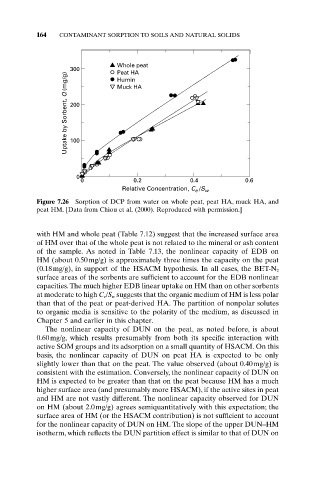
           Figure 7.26 Sorption of DCP from water on whole peat, peat HA, muck HA, and
           peat HM. [Data from Chiou et al. (2000). Reproduced with permission.]


           with HM and whole peat (Table 7.12) suggest that the increased surface area
           of HM over that of the whole peat is not related to the mineral or ash content
           of the sample. As noted in Table 7.13, the nonlinear capacity of EDB on
           HM (about 0.50mg/g) is approximately three times the capacity on the peat
           (0.18mg/g), in support of the HSACM hypothesis. In all cases, the BET-N 2
           surface areas of the sorbents are sufficient to account for the EDB nonlinear
           capacities. The much higher EDB linear uptake on HM than on other sorbents
           at moderate to high C e/S w suggests that the organic medium of HM is less polar
           than that of the peat or peat-derived HA. The partition of nonpolar solutes
           to organic media is sensitive to the polarity of the medium, as discussed in
           Chapter 5 and earlier in this chapter.
              The nonlinear capacity of DUN on the peat, as noted before, is about
           0.60mg/g, which results presumably from both its specific interaction with
           active SOM groups and its adsorption on a small quantity of HSACM. On this
           basis, the nonlinear capacity of DUN on peat HA is expected to be only
           slightly lower than that on the peat. The value observed (about 0.40mg/g) is
           consistent with the estimation. Conversely, the nonlinear capacity of DUN on
           HM is expected to be greater than that on the peat because HM has a much
           higher surface area (and presumably more HSACM), if the active sites in peat
           and HM are not vastly different. The nonlinear capacity observed for DUN
           on HM (about 2.0mg/g) agrees semiquantitatively with this expectation; the
           surface area of HM (or the HSACM contribution) is not sufficient to account
           for the nonlinear capacity of DUN on HM. The slope of the upper DUN–HM
           isotherm, which reflects the DUN partition effect is similar to that of DUN on

