


Page 164 - Partition & Adsorption of Organic Contaminants in Environmental Systems
P. 164
SORPTION FROM WATER SOLUTION     155

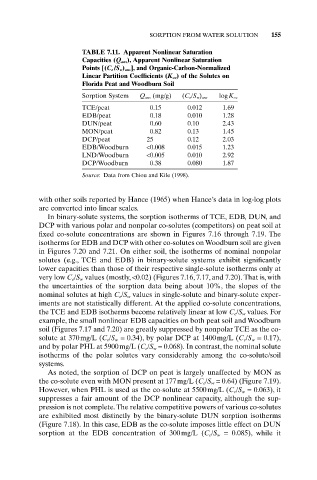
                        TABLE 7.11. Apparent Nonlinear Saturation
                        Capacities (Q ans), Apparent Nonlinear Saturation
                        Points [(C e /S w) ans], and Organic-Carbon-Normalized
                        Linear Partition Coefficients (K oc) of the Solutes on
                        Florida Peat and Woodburn Soil
                        Sorption System  Q ans (mg/g)  (C e/S w) ans  logK oc
                        TCE/peat           0.15      0.012     1.69
                        EDB/peat           0.18      0.010     1.28
                        DUN/peat           0.60      0.10      2.43
                        MON/peat           0.82      0.13      1.45
                        DCP/peat          25         0.12      2.03
                        EDB/Woodburn      <0.008     0.015     1.23
                        LND/Woodburn      <0.005     0.010     2.92
                        DCP/Woodburn       0.38      0.080     1.87
                        Source: Data from Chiou and Kile (1998).


            with other soils reported by Hance (1965) when Hance’s data in log-log plots
            are converted into linear scales.
              In binary-solute systems, the sorption isotherms of TCE, EDB, DUN, and
            DCP with various polar and nonpolar co-solutes (competitors) on peat soil at
            fixed co-solute concentrations are shown in Figures 7.16 through 7.19. The
            isotherms for EDB and DCP with other co-solutes on Woodburn soil are given
            in Figures 7.20 and 7.21. On either soil, the isotherms of nominal nonpolar
            solutes (e.g., TCE and EDB) in binary-solute systems exhibit significantly
            lower capacities than those of their respective single-solute isotherms only at
            very low C e/S w values (mostly, <0.02) (Figures 7.16, 7.17, and 7.20). That is, with
            the uncertainties of the sorption data being about 10%, the slopes of the
            nominal solutes at high C e /S w values in single-solute and binary-solute exper-
            iments are not statistically different. At the applied co-solute concentrations,
            the TCE and EDB isotherms become relatively linear at low C e /S w values. For
            example, the small nonlinear EDB capacities on both peat soil and Woodburn
            soil (Figures 7.17 and 7.20) are greatly suppressed by nonpolar TCE as the co-
            solute at 370mg/L (C e /S w = 0.34), by polar DCP at 1400mg/L (C e /S w = 0.17),
            and by polar PHL at 5900mg/L (C e /S w = 0.068). In contrast, the nominal solute
            isotherms of the polar solutes vary considerably among the co-solute/soil
            systems.
              As noted, the sorption of DCP on peat is largely unaffected by MON as
            the co-solute even with MON present at 177mg/L (C e/S w = 0.64) (Figure 7.19).
            However, when PHL is used as the co-solute at 5500mg/L (C e/S w = 0.063), it
            suppresses a fair amount of the DCP nonlinear capacity, although the sup-
            pression is not complete. The relative competitive powers of various co-solutes
            are exhibited most distinctly by the binary-solute DUN sorption isotherms
            (Figure 7.18). In this case, EDB as the co-solute imposes little effect on DUN
            sorption at the EDB concentration of 300mg/L (C e/S w = 0.085), while it

