


Page 157 - Partition & Adsorption of Organic Contaminants in Environmental Systems
P. 157
148   CONTAMINANT SORPTION TO SOILS AND NATURAL SOLIDS

           oil level exceeds this threshold capacity. This saturation effect is generally
           applicable to any soils contaminated by oils or other organic liquids. Soils with
           high SOM contents will thus take up a relatively large quantity of oils before
           a separate oil phase emerges, and vice versa for soils with low SOM contents.
           The observed PCB-oil saturation capacity in SOM, when expressed in liquid
           volume, is comparable in magnitude to the values for other nonpolar liquids,
           as given in Tables 7.2 and 7.21. Information on whether a separate organic
           phase exists in a contaminated soil is essential to the behavior and fate of both
           preexisting and incoming contaminants and to the strategy to be taken for soil
           remediation.
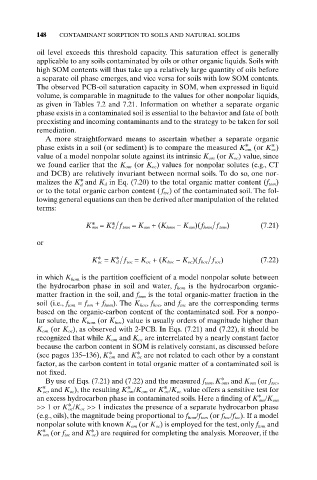
              A more straightforward means to ascertain whether a separate organic
           phase exists in a soil (or sediment) is to compare the measured K* (or K* )
                                                                     om
                                                                            oc
           value of a model nonpolar solute against its intrinsic K om (or K oc) value, since
           we found earlier that the K om (or K oc) values for nonpolar solutes (e.g., CT
           and DCB) are relatively invariant between normal soils. To do so, one nor-
           malizes the K* and K d in Eq. (7.20) to the total organic matter content (f tom)
                       d
           or to the total organic carbon content ( f toc) of the contaminated soil. The fol-
           lowing general equations can then be derived after manipulation of the related
           terms:

                         K* = K* f tom = K om + (K hom - K om)(f hom f tom)  (7.21)
                           om
                                d
           or

                           K* = K* f toc = K oc + (K hoc - K oc)(f hoc f toc)  (7.22)
                            oc
                                 d
           in which K hom is the partition coefficient of a model nonpolar solute between
           the hydrocarbon phase in soil and water, f hom is the hydrocarbon organic-
           matter fraction in the soil, and f tom is the total organic-matter fraction in the
           soil (i.e., f tom = f om + f hom). The K hoc, f hoc, and f toc are the corresponding terms
           based on the organic-carbon content of the contaminated soil. For a nonpo-
           lar solute, the K hom (or K hoc) value is usually orders of magnitude higher than
           K om (or K oc), as observed with 2-PCB. In Eqs. (7.21) and (7.22), it should be
           recognized that while K om and K oc are interrelated by a nearly constant factor
           because the carbon content in SOM is relatively constant, as discussed before
           (see pages 135–136), K* and K* are not related to each other by a constant
                                       oc
                               om
           factor, as the carbon content in total organic matter of a contaminated soil is
           not fixed.
              By use of Eqs. (7.21) and (7.22) and the measured f tom , K* , and K om (or f toc ,
                                                               om
           K* , and K oc ), the resulting K* /K om or K* /K oc value offers a sensitive test for
             oc
                                               oc
                                    om
                                                                         om
           an excess hydrocarbon phase in contaminated soils. Here a finding of K* /K om
           >> 1 or K* /K oc >> 1 indicates the presence of a separate hydrocarbon phase
                    oc
           (e.g., oils), the magnitude being proportional to f hom /f tom (or f hoc /f toc ). If a model
           nonpolar solute with known K om (or K oc ) is employed for the test, only f tom and
           K* (or f toc and K* ) are required for completing the analysis. Moreover, if the
             om
                          oc

