


Page 189 - Partition & Adsorption of Organic Contaminants in Environmental Systems
P. 189
180   CONTAMINANT SORPTION TO SOILS AND NATURAL SOLIDS

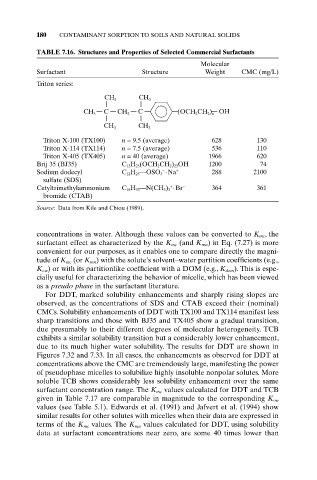
           TABLE 7.16. Structures and Properties of Selected Commercial Surfactants
                                                         Molecular
           Surfactant                   Structure         Weight    CMC (mg/L)
           Triton series:
                              CH 3      CH 3

                        CH 3  C   CH 2  C         (OCH CH )   OH
                                                       2
                                                           2 n
                                       CH
                              CH 3        3
             Triton X-100 (TX100)  n = 9.5 (average)        628         130
             Triton X-114 (TX114)  n = 7.5 (average)        536         110
             Triton X-405 (TX405)  n = 40 (average)        1966         620
           Brij 35 (BJ35)          C 12H 25(OCH 2CH 2) 23OH  1200        74
                                              -
           Sodium dodecyl          C 12H 25—OSO 3 ◊Na +     288        2100
             sulfate (SDS)
                                                +
           Cetyltrimethylammonium  C 16H 33—N(CH 3) 3 ◊Br -  364        361
             bromide (CTAB)
           Source: Data from Kile and Chiou (1989).


           concentrations in water. Although these values can be converted to K mc,the
           surfactant effect as characterized by the K mc (and K mn) in Eq. (7.27) is more
           convenient for our purposes, as it enables one to compare directly the magni-
           tude of K mc (or K mn) with the solute’s solvent–water partition coefficients (e.g.,
           K ow) or with its partitionlike coefficient with a DOM (e.g., K dom). This is espe-
           cially useful for characterizing the behavior of micelle, which has been viewed
           as a pseudo phase in the surfactant literature.
              For DDT, marked solubility enhancements and sharply rising slopes are
           observed, as the concentrations of SDS and CTAB exceed their (nominal)
           CMCs. Solubility enhancements of DDT with TX100 and TX114 manifest less
           sharp transitions and those with BJ35 and TX405 show a gradual transition,
           due presumably to their different degrees of molecular heterogeneity. TCB
           exhibits a similar solubility transition but a considerably lower enhancement,
           due to its much higher water solubility. The results for DDT are shown in
           Figures 7.32 and 7.33. In all cases, the enhancements as observed for DDT at
           concentrations above the CMC are tremendously large, manifesting the power
           of pseudophase micelles to solubilize highly insoluble nonpolar solutes. More
           soluble TCB shows considerably less solubility enhancement over the same
           surfactant concentration range. The K mc values calculated for DDT and TCB
           given in Table 7.17 are comparable in magnitude to the corresponding K ow
           values (see Table 5.1). Edwards et al. (1991) and Jafvert et al. (1994) show
           similar results for other solutes with micelles when their data are expressed in
           terms of the K mc values. The K mn values calculated for DDT, using solubility
           data at surfactant concentrations near zero, are some 40 times lower than

