


Page 192 - Partition & Adsorption of Organic Contaminants in Environmental Systems
P. 192
SORPTION FROM WATER SOLUTION     183

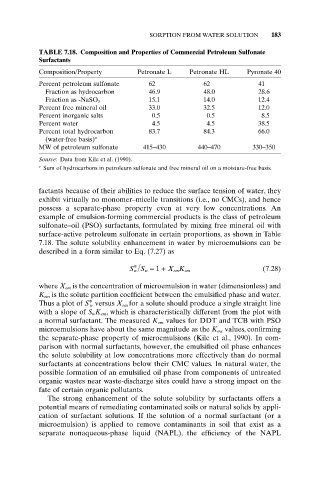
            TABLE 7.18. Composition and Properties of Commercial Petroleum Sulfonate
            Surfactants
            Composition/Property       Petronate L    Petronate HL    Pyronate 40
            Percent petroleum sulfonate   62             62              41
              Fraction as hydrocarbon     46.9           48.0            28.6
                                          15.1           14.0            12.4
              Fraction as -NaSO 3
            Percent free mineral oil      33.0           32.5            12.0
            Percent inorganic salts        0.5            0.5             8.5
            Percent water                  4.5            4.5            38.5
            Percent total hydrocarbon     83.7           84.3            66.0
              (water-free basis) a
            MW of petroleum sulfonate    415–430        440–470        330–350
            Source: Data from Kile et al. (1990).
            a  Sum of hydrocarbons in petroleum sulfonate and free mineral oil on a moisture-free basis.


            factants because of their abilities to reduce the surface tension of water, they
            exhibit virtually no monomer–micelle transitions (i.e., no CMCs), and hence
            possess a separate-phase property even at very low concentrations. An
            example of emulsion-forming commercial products is the class of petroleum
            sulfonate–oil (PSO) surfactants, formulated by mixing free mineral oil with
            surface-active petroleum sulfonate in certain proportions, as shown in Table
            7.18. The solute solubility enhancement in water by microemulsions can be
            described in a form similar to Eq. (7.27) as

                                                                          (7.28)
                                     S* S w = 1 + X emK em
                                      w
            where X em is the concentration of microemulsion in water (dimensionless) and
            K em is the solute partition coefficient between the emulsified phase and water.
            Thus a plot of S* versus X em for a solute should produce a single straight line
                          w
            with a slope of S w K em , which is characteristically different from the plot with
            a normal surfactant. The measured K em values for DDT and TCB with PSO
            microemulsions have about the same magnitude as the K mc values, confirming
            the separate-phase property of microemulsions (Kile et al., 1990). In com-
            parison with normal surfactants, however, the emulsified oil phase enhances
            the solute solubility at low concentrations more effectively than do normal
            surfactants at concentrations below their CMC values. In natural water, the
            possible formation of an emulsified oil phase from components of untreated
            organic wastes near waste-discharge sites could have a strong impact on the
            fate of certain organic pollutants.
              The strong enhancement of the solute solubility by surfactants offers a
            potential means of remediating contaminated soils or natural solids by appli-
            cation of surfactant solutions. If the solution of a normal surfactant (or a
            microemulsion) is applied to remove contaminants in soil that exist as a
            separate nonaqueous-phase liquid (NAPL), the efficiency of the NAPL

