


Page 193 - Partition & Adsorption of Organic Contaminants in Environmental Systems
P. 193
184   CONTAMINANT SORPTION TO SOILS AND NATURAL SOLIDS

           removal may be described by Eqs. (7.27) and (7.28), provided that the sur-
           factant solution readily reaches the surfaces of soil particles and penetrates
           into their void spaces. For the NAPL-saturated soil, the sorption of surfactants
           to the soil should be small compared to the amount of NAPL retained by soil
           and therefore should not significantly alter the overall NAPL sorption by the
           soil. On the other hand, if the contaminants exist at subsaturated levels in the
           soil or a natural solid (i.e., no NAPL or excess contaminant phase is formed),
           the applied surfactant solution may produce disparate results, depending on
           the system, as described below.
              Let us consider the situation for a contaminant at subsaturated level in a
           soil–water system to which a surfactant is applied. To begin with, one must
           recognize that there are fundamental differences in molecular properties
           between surfactants and common organic compounds that affect their inter-
           actions with soils or other solids. Most commercial and certain natural sur-
           factants contain powerful ionic or polar head groups (as needed to keep them
           stabilized in water) that are attached to relatively long nonpolar tails. The high
           polarity and molecular weight of many surfactants (e.g., nonionic and cationic
           surfactants) enable them to compete more efficiently against water for adsorp-
           tion onto certain soil minerals,besides their partition into SOM. In the absence
           of a separate contaminant phase, adsorption of the surfactant on minerals may
           induce the uptake of other contaminants onto or into the mineral-adsorbed
           surfactant phase and consequently affect the distribution coefficient of a con-
           taminant. The simultaneous effects of soil-sorbed surfactants on contaminant
           sorption and unsorbed aqueous surfactants on contaminant dissolution have
           been addressed by Sun and Boyd (1993), Chiou (1998), and Lee et al. (2000)
           to delineate the consequent change in contaminant sorption coefficient. By
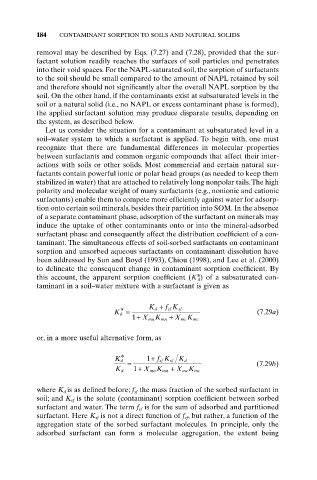
           this account, the apparent sorption coefficient (K*) of a subsaturated con-
                                                        d
           taminant in a soil–water mixture with a surfactant is given as

                                          K d +  f K sf
                                                sf
                                  *
                                 K d =                                  (7.29a)
                                      1 +  X mn K mn +  X K mc
                                                   mc
           or, in a more useful alternative form, as

                                   *      1 +
                                             sf
                                 K d         fK sf  K d
                                    =                                   (7.29b)
                                                    mc
                                 K d  1  +  X mn K mn +  X K mc
           where K d is as defined before; f sf the mass fraction of the sorbed surfactant in
           soil; and K sf is the solute (contaminant) sorption coefficient between sorbed
           surfactant and water. The term f sf is for the sum of adsorbed and partitioned
           surfactant. Here K sf is not a direct function of f sf , but rather, a function of the
           aggregation state of the sorbed surfactant molecules. In principle, only the
           adsorbed surfactant can form a molecular aggregation, the extent being

