


Page 198 - Partition & Adsorption of Organic Contaminants in Environmental Systems
P. 198
SORPTION FROM WATER SOLUTION     189

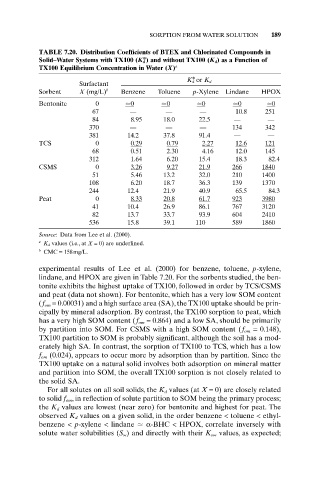
            TABLE 7.20. Distribution Coefficients of BTEX and Chlorinated Compounds in
            Solid–Water Systems with TX100 (K*) and without TX100 (K d) as a Function of
                                         d
            TX100 Equilibrium Concentration in Water (X) a
                                                      d
                                                     K* or K d
                       Surfactant
            Sorbent    X (mg/L) b  Benzene   Toluene   p-Xylene  Lindane  HPOX
            Bentonite       0        0         0         0         0        0
                           67        —         —        —         10.8     251
                           84        8.95     18.0      22.5      —        —
                          370        —         —        —        134       342
                          381       14.2      37.8      91.4      —        —
            TCS             0        0.29      0.79      2.27     12.6     121
                           68        0.51      2.30      4.16     12.0     145
                          312        1.64      6.20     15.4      18.3      82.4
            CSMS            0        3.26      9.27     21.9     266      1840
                           51        5.46     13.2      32.0      210     1400
                          108        6.20     18.7      36.3      139     1370
                          244       12.4      21.9      40.9      65.5      84.3
            Peat            0        8.33     20.8      61.7     923      3980
                           41       10.4      26.9      86.1      767     3120
                           82       13.7      33.7      93.9      604     2410
                          536       15.8      39.1     110        589     1860
            Source: Data from Lee et al. (2000).
            a
             K d values (i.e., at X = 0) are underlined.
            b
             CMC = 158mg/L.
            experimental results of Lee et al. (2000) for benzene, toluene, p-xylene,
            lindane, and HPOX are given in Table 7.20. For the sorbents studied, the ben-
            tonite exhibits the highest uptake of TX100, followed in order by TCS/CSMS
            and peat (data not shown). For bentonite, which has a very low SOM content
            (f om = 0.00031) and a high surface area (SA), the TX100 uptake should be prin-
            cipally by mineral adsorption. By contrast, the TX100 sorption to peat, which
            has a very high SOM content (f om = 0.864) and a low SA, should be primarily
            by partition into SOM. For CSMS with a high SOM content (f om = 0.148),
            TX100 partition to SOM is probably significant, although the soil has a mod-
            erately high SA. In contrast, the sorption of TX100 to TCS, which has a low
            f om (0.024), appears to occur more by adsorption than by partition. Since the
            TX100 uptake on a natural solid involves both adsorption on mineral matter
            and partition into SOM, the overall TX100 sorption is not closely related to
            the solid SA.
              For all solutes on all soil solids, the K d values (at X = 0) are closely related
            to solid f om, in reflection of solute partition to SOM being the primary process;
            the K d values are lowest (near zero) for bentonite and highest for peat. The
            observed K d values on a given solid, in the order benzene < toluene < ethyl-
            benzene  < p-xylene  < lindane    a-BHC  < HPOX, correlate inversely with
            solute water solubilities (S w) and directly with their K ow values, as expected;

