


Page 202 - Partition & Adsorption of Organic Contaminants in Environmental Systems
P. 202
SORPTION FROM ORGANIC SOLVENTS     193

                     4000     Oxidized soil


                    Uptake by Soil, Q   (mg/kg)  3000


                     2000


                     1000

                                                 Organic soil (peat)

                        0
                         0      2       4       6       8      10      12
                                  Equilibrium Concentration, C (mg/L)
                                                         e
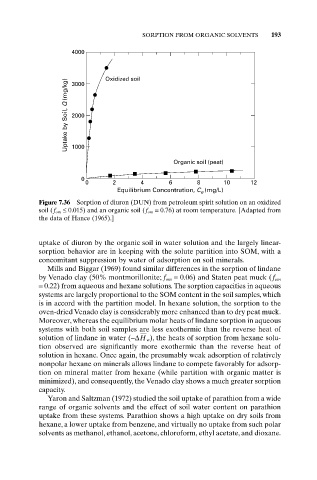
            Figure 7.36 Sorption of diuron (DUN) from petroleum spirit solution on an oxidized
            soil (f om £ 0.015) and an organic soil (f om = 0.76) at room temperature. [Adapted from
            the data of Hance (1965).]


            uptake of diuron by the organic soil in water solution and the largely linear-
            sorption behavior are in keeping with the solute partition into SOM, with a
            concomitant suppression by water of adsorption on soil minerals.
              Mills and Biggar (1969) found similar differences in the sorption of lindane
            by Venado clay (50% montmorillonite; f om = 0.06) and Staten peat muck (f om
            = 0.22) from aqueous and hexane solutions. The sorption capacities in aqueous
            systems are largely proportional to the SOM content in the soil samples, which
            is in accord with the partition model. In hexane solution, the sorption to the
            oven-dried Venado clay is considerably more enhanced than to dry peat muck.
            Moreover, whereas the equilibrium molar heats of lindane sorption in aqueous
            systems with both soil samples are less exothermic than the reverse heat of
            solution of lindane in water (-DH  w), the heats of sorption from hexane solu-
            tion observed are significantly more exothermic than the reverse heat of
            solution in hexane. Once again, the presumably weak adsorption of relatively
            nonpolar hexane on minerals allows lindane to compete favorably for adsorp-
            tion on mineral matter from hexane (while partition with organic matter is
            minimized), and consequently, the Venado clay shows a much greater sorption
            capacity.
              Yaron and Saltzman (1972) studied the soil uptake of parathion from a wide
            range of organic solvents and the effect of soil water content on parathion
            uptake from these systems. Parathion shows a high uptake on dry soils from
            hexane, a lower uptake from benzene, and virtually no uptake from such polar
            solvents as methanol, ethanol, acetone, chloroform, ethyl acetate, and dioxane.

