


Page 204 - Partition & Adsorption of Organic Contaminants in Environmental Systems
P. 204
SORPTION FROM ORGANIC SOLVENTS     195

                     5000


                     4000                         Parathion
                   Uptake by Soil, Q   (µg/g)  3000  2,4' -PCB
                                                  Lindane

                                                  1,2 -Dichlorobenzene


                     2000


                     1000


                       0
                        0             200             400             600
                                 Equilibrium Concentration, C (mg/L)
                                                        e
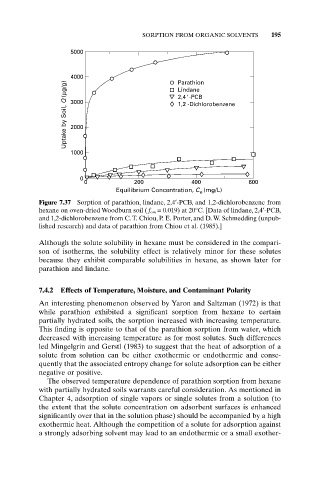
            Figure 7.37 Sorption of parathion, lindane, 2,4¢-PCB, and 1,2-dichlorobenzene from
            hexane on oven-dried Woodburn soil ( f om = 0.019) at 20°C. [Data of lindane, 2,4¢-PCB,
            and 1,2-dichlorobenzene from C. T. Chiou, P. E. Porter, and D. W. Schmedding (unpub-
            lished research) and data of parathion from Chiou et al. (1985).]

            Although the solute solubility in hexane must be considered in the compari-
            son of isotherms, the solubility effect is relatively minor for these solutes
            because they exhibit comparable solubilities in hexane, as shown later for
            parathion and lindane.


            7.4.2 Effects of Temperature, Moisture, and Contaminant Polarity
            An interesting phenomenon observed by Yaron and Saltzman (1972) is that
            while parathion exhibited a significant sorption from hexane to certain
            partially hydrated soils, the sorption increased with increasing temperature.
            This finding is opposite to that of the parathion sorption from water, which
            decreased with increasing temperature as for most solutes. Such differences
            led Mingelgrin and Gerstl (1983) to suggest that the heat of adsorption of a
            solute from solution can be either exothermic or endothermic and conse-
            quently that the associated entropy change for solute adsorption can be either
            negative or positive.
              The observed temperature dependence of parathion sorption from hexane
            with partially hydrated soils warrants careful consideration. As mentioned in
            Chapter 4, adsorption of single vapors or single solutes from a solution (to
            the extent that the solute concentration on adsorbent surfaces is enhanced
            significantly over that in the solution phase) should be accompanied by a high
            exothermic heat. Although the competition of a solute for adsorption against
            a strongly adsorbing solvent may lead to an endothermic or a small exother-

