


Page 206 - Partition & Adsorption of Organic Contaminants in Environmental Systems
P. 206
SORPTION FROM ORGANIC SOLVENTS     197

                     5000
                           (a)                    -80             (b)
                   Uptake of Parathion by Soil, Q   (µg/g)  3000  Oven-dried, 20°C  H ads  (kJ/mol)  -40 0  3000  h Q (µg/g)  5000
                     4000


                                                       –   H
                                 Oven-dried, 30°C
                                 Air-dried, 20°C
                                                             4000
                     2000
                                 Air-dried, 30°C

                     1000


                       0
                        0             200             400             600
                                 Equilibrium Concentration, C (mg/L)
                                                        e
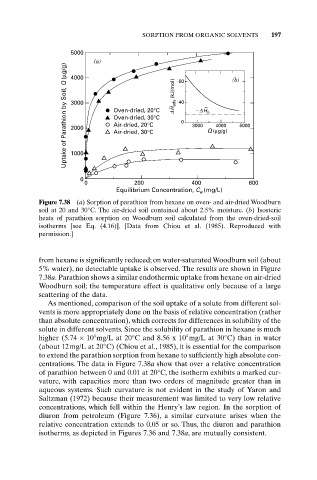
            Figure 7.38 (a) Sorption of parathion from hexane on oven- and air-dried Woodburn
            soil at 20 and 30°C. The air-dried soil contained about 2.5% moisture. (b) Isosteric
            heats of parathion sorption on  Woodburn soil calculated from the oven-dried-soil
            isotherms [see Eq. (4.16)]. [Data from Chiou et al. (1985). Reproduced with
            permission.]


            from hexane is significantly reduced; on water-saturated Woodburn soil (about
            5% water), no detectable uptake is observed. The results are shown in Figure
            7.38a. Parathion shows a similar endothermic uptake from hexane on air-dried
            Woodburn soil; the temperature effect is qualitative only because of a large
            scattering of the data.
              As mentioned, comparison of the soil uptake of a solute from different sol-
            vents is more appropriately done on the basis of relative concentration (rather
            than absolute concentration), which corrects for differences in solubility of the
            solute in different solvents. Since the solubility of parathion in hexane is much
                           4
                                                     4
            higher (5.74 ¥ 10 mg/L at 20°C and 8.56 x 10 mg/L at 30°C) than in water
            (about 12mg/L at 20°C) (Chiou et al., 1985), it is essential for the comparison
            to extend the parathion sorption from hexane to sufficiently high absolute con-
            centrations. The data in Figure 7.38a show that over a relative concentration
            of parathion between 0 and 0.01 at 20°C, the isotherm exhibits a marked cur-
            vature, with capacities more than two orders of magnitude greater than in
            aqueous systems. Such curvature is not evident in the study of Yaron and
            Saltzman (1972) because their measurement was limited to very low relative
            concentrations, which fell within the Henry’s law region. In the sorption of
            diuron from petroleum (Figure 7.36), a similar curvature arises when the
            relative concentration extends to 0.05 or so. Thus, the diuron and parathion
            isotherms, as depicted in Figures 7.36 and 7.38a, are mutually consistent.

