


Page 211 - Partition & Adsorption of Organic Contaminants in Environmental Systems
P. 211
202   CONTAMINANT SORPTION TO SOILS AND NATURAL SOLIDS

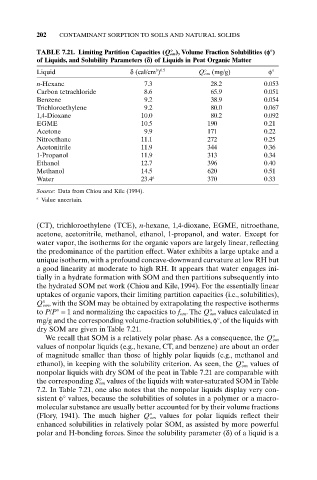
           TABLE 7.21. Limiting Partition Capacities (Q° om ), Volume Fraction Solubilities (f°)
           of Liquids, and Solubility Parameters (d) of Liquids in Peat Organic Matter
                                            3 0.5
           Liquid                    d (cal/cm )        Q° om (mg/g)        f°
           n-Hexane                      7.3                28.2          0.053
           Carbon tetrachloride          8.6               65.9           0.051
           Benzene                       9.2                38.9          0.054
           Trichloroethylene             9.2               80.0           0.067
           1,4-Dioxane                  10.0                80.2          0.092
           EGME                         10.5               190            0.21
           Acetone                       9.9               171            0.22
           Nitroethane                  11.1               272            0.25
           Acetonitrile                 11.9               344            0.36
           1-Propanol                   11.9               313            0.34
           Ethanol                      12.7               396            0.40
           Methanol                     14.5               620            0.51
           Water                        23.4  a            370            0.33
           Source: Data from Chiou and Kile (1994).
           a  Value uncertain.


           (CT), trichloroethylene (TCE), n-hexane, 1,4-dioxane, EGME, nitroethane,
           acetone, acetonitrile, methanol, ethanol, 1-propanol, and water. Except for
           water vapor, the isotherms for the organic vapors are largely linear, reflecting
           the predominance of the partition effect. Water exhibits a large uptake and a
           unique isotherm, with a profound concave-downward curvature at low RH but
           a good linearity at moderate to high RH. It appears that water engages ini-
           tially in a hydrate formation with SOM and then partitions subsequently into
           the hydrated SOM net work (Chiou and Kile, 1994). For the essentially linear
           uptakes of organic vapors, their limiting partition capacities (i.e., solubilities),
           Q° om, with the SOM may be obtained by extrapolating the respective isotherms
           to P/P° = 1 and normalizing the capacities to f om. The Q° om values calculated in
           mg/g and the corresponding volume-fraction solubilities, f°, of the liquids with
           dry SOM are given in Table 7.21.
              We recall that SOM is a relatively polar phase. As a consequence, the Q° om
           values of nonpolar liquids (e.g., hexane, CT, and benzene) are about an order
           of magnitude smaller than those of highly polar liquids (e.g., methanol and
           ethanol), in keeping with the solubility criterion. As seen, the Q° om values of
           nonpolar liquids with dry SOM of the peat in Table 7.21 are comparable with
           the corresponding S° om values of the liquids with water-saturated SOM in Table
           7.2. In Table 7.21, one also notes that the nonpolar liquids display very con-
           sistent f° values, because the solubilities of solutes in a polymer or a macro-
           molecular substance are usually better accounted for by their volume fractions
           (Flory, 1941). The much higher  Q° om values for polar liquids reflect their
           enhanced solubilities in relatively polar SOM, as assisted by more powerful
           polar and H-bonding forces. Since the solubility parameter (d) of a liquid is a

