


Page 215 - Partition & Adsorption of Organic Contaminants in Environmental Systems
P. 215
206   CONTAMINANT SORPTION TO SOILS AND NATURAL SOLIDS

                       40

                                  Water (23.8°C)
                                  1,2,4-Trichlorobenzene
                                  Chlorobenzene
                                  m-Dichlorobenzene
                                  Benzene
                       30
                                  p-Dichlorobenzene
                      Uptake by Soil, Q    (mg/g)  20


                       10


                        0
                         0       0.2     0.4      0.6     0.8      1.0
                                      Relative Pressure, P/P°
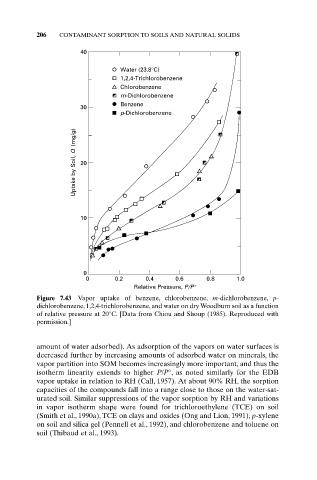
           Figure 7.43 Vapor uptake of benzene, chlorobenzene, m-dichlorobenzene, p-
           dichlorobenzene, 1,2,4-trichlorobenzene, and water on dry Woodburn soil as a function
           of relative pressure at 20°C. [Data from Chiou and Shoup (1985). Reproduced with
           permission.]


           amount of water adsorbed). As adsorption of the vapors on water surfaces is
           decreased further by increasing amounts of adsorbed water on minerals, the
           vapor partition into SOM becomes increasingly more important, and thus the
           isotherm linearity extends to higher  P/P°, as noted similarly for the EDB
           vapor uptake in relation to RH (Call, 1957). At about 90% RH, the sorption
           capacities of the compounds fall into a range close to those on the water-sat-
           urated soil. Similar suppressions of the vapor sorption by RH and variations
           in vapor isotherm shape were found for trichloroethylene (TCE) on soil
           (Smith et al., 1990a), TCE on clays and oxides (Ong and Lion, 1991), p-xylene
           on soil and silica gel (Pennell et al., 1992), and chlorobenzene and toluene on
           soil (Thibaud et al., 1993).

