


Page 216 - Partition & Adsorption of Organic Contaminants in Environmental Systems
P. 216
SORPTION FROM VAPOR PHASE     207

                        40

                                                            0% R.H.


                        30


                       Uptake by Soil, Q   (mg/g)  20


                                                      18% R.H.
                                                       50% R.H.

                        10


                                                            90% R.H.
                         0
                         0        0.2     0.4     0.6      0.8     1.0
                                      Relative Pressure, P/P°
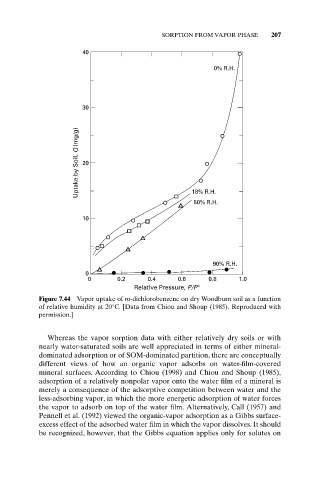
            Figure 7.44 Vapor uptake of m-dichlorobenzene on dry Woodburn soil as a function
            of relative humidity at 20°C. [Data from Chiou and Shoup (1985). Reproduced with
            permission.]


              Whereas the vapor sorption data with either relatively dry soils or with
            nearly water-saturated soils are well appreciated in terms of either mineral-
            dominated adsorption or of SOM-dominated partition, there are conceptually
            different views of how an organic vapor adsorbs on water-film-covered
            mineral surfaces. According to Chiou (1998) and Chiou and Shoup (1985),
            adsorption of a relatively nonpolar vapor onto the water film of a mineral is
            merely a consequence of the adsorptive competition between water and the
            less-adsorbing vapor, in which the more energetic adsorption of water forces
            the vapor to adsorb on top of the water film. Alternatively, Call (1957) and
            Pennell et al. (1992) viewed the organic-vapor adsorption as a Gibbs surface-
            excess effect of the adsorbed water film in which the vapor dissolves. It should
            be recognized, however, that the Gibbs equation applies only for solutes on

