


Page 191 - Petroleum Geology
P. 191
168

              Darcy's law has an upper limit, but this is rarely (if ever) exceeded in nature.
            No lower limit has been demonstrated. The intrinsic permeability  of  VYCOR,
            mentioned above, is of the order of     cm2, or lo-'  darcies.
               For any porous and  permeable  material,  the intrinsic permeability  can be
            determined experimentally using any liquid - for example, oil or water:
            k  =  qwqwl/PwgAhw =  qoV01/p&Aho.                                 (8.9)
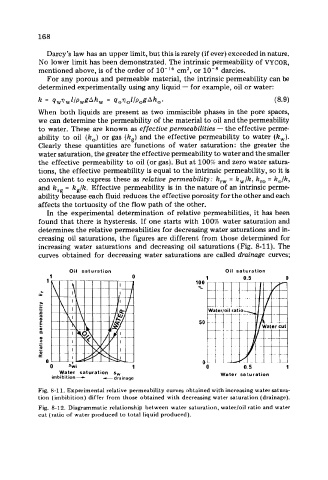
            When  both  liquids are present  as two  immiscible phases  in the pore  spaces,
            we can determine the permeability of the material to oil and the permeability
            to water.  These  are known  as effective permeabilities - the effective perme-
            ability  to  oil  (k,)  or gas (kg) and the effective permeability  to water  (kw).
            Clearly  these  quantities  are  functions  of  water  saturation:  the greater  the
            water saturation, the greater the effective permeability to water and the smaller
            the effective permeability  to oil (or gas). But at 100% and zero water satura-
            tions, the effective  permeability is equal to the intrinsic permeability,  so it is
            convenient to express these as relative permeability: krw = kw/k, k,,  = ko/k,
            and krg = kg/k.  Effective  permeability  is  in the nature of an intrinsic perme-
            ability because each fluid reduces the effective porosity for the other and each
            affects the tortuosity of the flow path of the other.
              In  the experimental  determination  of  relative  permeabilities,  it has been
            found  that there is hysteresis.  If  one starts with  100% water  saturation and
            determines the relative permeabilities for decreasing water saturations and in-
            creasing  oil saturations, the figures are different  from those determined  for
            increasing  water  saturations  and  decreasing  oil saturations (Fig. 8-1 1). The
            curves  obtained  for  decreasing water saturations are called  drainage curves;

                     Oil  saturation                             Oil  saturation
               1                       n                    1         0.5          0
              1                                          100
                                                          %
             L
            -k


                                                          50


              0                                            a
                                       1                    0          0.5         1
                  Water  saturation  sw                         Water  saturation
                irnbibition-   -drainage
            Fig. 8-1 1. Experimental  relative permeability  curves obtained with increasing water satura-
            tion (imbibition) differ from  those  obtained  with  decreasing water saturation  (drainage).
            Fig. 8-12. Diagrammatic  relationship  between water  saturation, waterloil ratio and water
            cut (ratio of water produced  to total liquid produced).

