


Page 193 - Petroleum Geology
P. 193
170

              We  shall consider only the simplest aspects of  oil-well production that will
            enable us to reach the point  of  understanding the nature of the process. We
            shall first consider an oil well producing without gas or water from an inclined
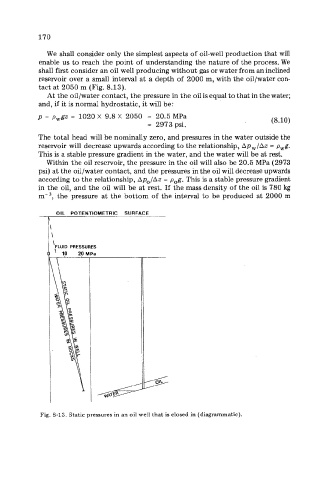
            reservoir over a small interval at a depth of  2000 m, with the oil/water con-
            tact at 2050 m (Fig. 8.13).
              At the oil/water contact, the pressure in the oil is equal to that in the water;
            and, if  it is normal hydrostatic, it will be:
            p =  p,gz   =  1020 X  9.8 X  2050  =  20.5 MPa                   (8.10)
                                           =  2973psi.
            The total head will be nominally zero, and pressures in the water outside the
            reservoir will decrease upwards according to the relationship, Apw/Az = p,g.
            This is a stable pressure gradient in the water, and the water will be at rest.
              Within the oil reservoir, the pressure in the oil will also be 20.5 MPa (2973
            psi) at the oil/water contact, and the pressures in the oil will decrease upwards
            according to the relationship, Apo/Az  = pog. This is a stable pressure gradient
            in the oil, and the oil will be at rest.  If  the mass density of  the oil is 780 kg
            m-3, the  pressure  at the bottom  of  the interval to be produced  at 2000 m


                 OIL  POTENTIOMETRIC  SURFACE
                ~~


                ?-          3           -
                ‘FLUID  PRESSURES


                  \


             Fig. 8-13. Static pressures in an oil well that is closed in (diagrammatic).

