


Page 490 - Petrophysics
P. 490
458    PETROPHYSICS: RESERVOIR ROCK PROPERTIES


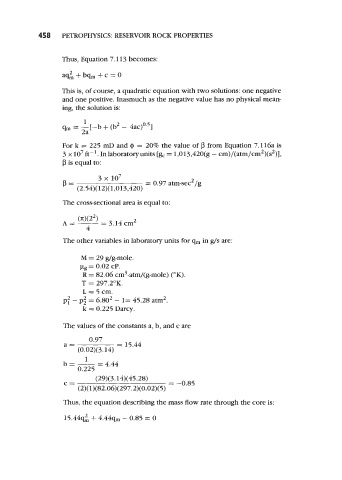
                    Thus, Equation 7.1 13 becomes:

                      2
                    aq,  + bqm fc = 0
                    This is, of course, a quadratic equation with two solutions: one negative
                    and one positive. Inasmuch as the negative value has no physical mean-
                    ing, the solution is:
                           1
                    qm = -[-b  + (b2 - 4a~)'.~]
                          2a
                    For k = 225 mD and 9 = 20%  the value of p from Equation 7.116a is
                    3 x lo7 ft-l.  Inlaboratoryunits [g,  = 1,013,420(g - cm)/(atm/cm2)(s2)],
                    p is equal to:

                               3  x 10'      = 0.97 atm-sec2/g
                      = (2.54)( 12)( 1,013,420)

                    The cross-sectional area is equal to:


                           4
                    The other variables in laboratory units for qm in g/s are:

                          M = 29 g/g-mole.
                         pg = 0.02 CP.
                          R = 82.06 cm3-atm/(g-mole) (OK).
                          T = 297.2"K.
                          L=5cm.
                    p:  - pi = 6.802 - 1=  45.28 atm2.
                          k = 0.225 Darcy.

                    The values of the constants a, b, and c are

                            0.97
                     a=              = 15.44
                         (0.02)(3.14)
                           1
                    b=--       - 4.44
                         0.225
                              (29)(3.14)(45.28)
                     C=                             = -0.85
                         (2)(  1)(82.06)(297.2)(0.02)(5)

                    Thus, the equation describing the mass flow rate through the core is:

                     15.449;  + 4.44qm - 0.85 = 0

