


Page 491 - Petrophysics
P. 491
TURBULENT FLOW OF GAS            459


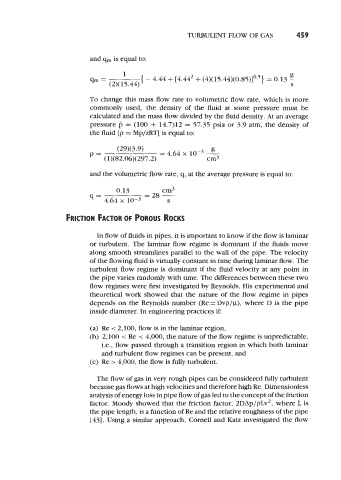
                            and qm  is equal to:


                                       1                                                 g
                             qm  =          { - 4.44 + [4.4d2 + (4)(15.44)(0.85)]0.5} = 0.13 -
                                  (2)( 1 5.44)                                            S
                            To change this mass flow rate to volumetric flow rate, which is more
                            commonly  used,  the  density of  the  fluid  at  some  pressure must  be
                            calculated and the mass flow divided by the fluid density. At an average
                            pressure p = (100 + 14.312 = 57.35 psia or 3.9 atm, the density of
                            the fluid [p = Mp/zRT] is equal to:


                            and the volumetric flow rate, q, at the average pressure is equal to:

                                     0.13    = 28 -
                                                   cm3
                                 4.64 x  10-3       S
                     FRICTION FACTOR OF POROUS ROCKS


                               In flow of fluids in pipes, it is important to know if the flow is laminar
                            or turbulent. The laminar flow regime is dominant if  the fluids move
                            along smooth streamlines parallel to the wall of  the pipe. The velocity
                            of the flowing fluid is virtually constant in time during laminar flow. The
                            turbulent flow regime is dominant if  the fluid velocity at any point in
                            the pipe varies randomly with time. The differences between these two
                            flow regimes were first investigated by Reynolds. His experimental and
                            theoretical work showed that the nature of  the flow regime in pipes
                            depends on the Reynolds number (Re=Dvp/y),  where D is the pipe
                            inside diameter. In engineering practices if:


                             (a)  Re < 2,100, flow is in the laminar region,
                            (b)  2,100 < Re  e 4,000, the nature of the flow regime is unpredictable,
                                i.e., flow passed through a transition region in which both laminar
                                and turbulent flow regimes can be present, and
                             (c) Re > 4,000, the flow is fully turbulent.

                               The flow of gas in very rough pipes can be considered fully turbulent
                            because gas flows at high velocities and therefore high Re. Dimensionless
                            analysis of energy loss in pipe flow of gas led to the concept of the friction
                            factor. Moody showed that the friction factor, 2DAp/pLv2, where L is
                            the pipe length, is a function of Re and the relative roughness of the pipe
                             [43]. Using a similar approach, Cornell and Katz investigated the flow

