


Page 537 - Petrophysics
P. 537
504    PETROPHYSJCS: RESERVOIR ROCK PROPERTIES


                           @f  = fracture porosity, fraction
                           @m  = matrix porosity, fraction
                           Swf  = water saturation in fractures, fraction
                           Swm = water saturation in matrix, fraction
                           Bo  = oil formation volume factor, bbl/STB.

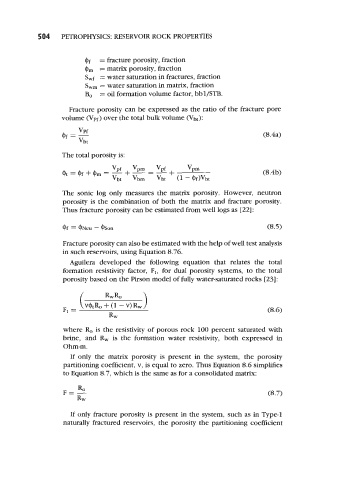
                      Fracture porosity can be expressed as the ratio of  the fracture pore
                    volume (Vpf) over the total bulk volume (Vbt):
                         VPf
                    Of  = -                                                      (8.4a)
                         Vbt

                    The total porosity is:

                                                                                 (8.4b)


                    The sonic log  only measures the matrix porosity.  However, neutron
                    porosity is the combination of  both the matrix  and fracture porosity.
                    Thus fracture porosity can be estimated from well logs as [22]:


                    Fracture porosity can also be estimated with the help of well test analysis
                    in such reservoirs, using Equation 8.76.
                      Aguilera  developed  the  following  equation  that  relates  the  total
                    formation resistivity factor, Ft, for dual porosity systems, to the total
                    porosity based on the Pirson model of fully water-saturated rocks [23]:


                    where Ro  is the resistivity of  porous rock  100 percent saturated with
                    brine,  and  Rw  is  the  formation water  resistivity,  both  expressed in
                    Ohm-m.
                      If  only  the  matrix  porosity  is  present  in  the  system,  the  porosity
                    partitioning coefficient, v, is equal to zero. Thus Equation 8.6 simplifies
                    to Equation 8.7, which is the same as for a consolidated matrix:


                      If  only fracture porosity is present in the system, such as in Type-1
                    naturally fractured reservoirs, the porosity the partitioning coefficient

