


Page 540 - Petrophysics
P. 540
PETROPHYSICAL PROPERTIES            507


                                           1000

                                        .-
                                        v)   800
                                        Q
                                        F“
                                        2  600
                                        v)
                                        F
                                        a
                                           400

                                           200


                                             0
                                              0          100        200        300
                                                 Volume of water injected, cc
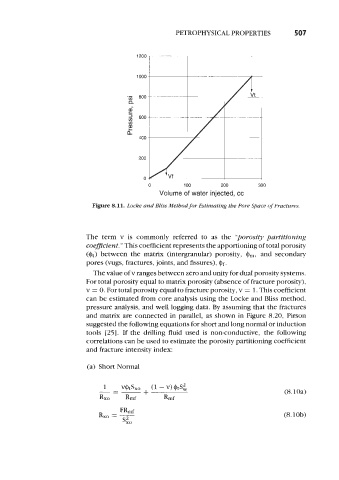
                             Figure 8.11. Locke and Bliss Method for Estimating the Pore Space of Fractures.


                           The  term  v  is  commonly  referred  to  as  the  “porosity partitioning
                           coefjcient.”  This coefficient represents the apportioning of total porosity
                           (@) between  the  matrix (intergranular) porosity,  @m, and  secondary
                           pores (vugs, fractures, joints, and fissures), @f.
                             The value of v ranges between zero and unity for dual porosity systems.
                           For total porosity equal to matrix porosity (absence of fracture porosity),
                           v = 0. For total porosity equal to fracture porosity, v = 1. This coefficient
                           can be estimated from core analysis using the Locke and Bliss method,
                           pressure analysis, and well logging data. By  assuming that the fractures
                           and matrix are connected in parallel, as shown in Figure 8.20, Pirson
                           suggested the following equations for short and long normal or induction
                           tools  [25]. If  the  drilling fluid used  is  non-conductive, the  following
                           correlations can be used to estimate the porosity partitioning coefficient
                           and fracture intensity index:

                           (a)  Short Normal


                                                                                       (8. loa)


                                                                                       (8.10b)

