


Page 542 - Petrophysics
P. 542
PETROPHYSICAL PROPERTIES            509


                           formations. The presence of fractures near the wellbore and their density
                           are factors that must be taken into account when estimating S,,,.
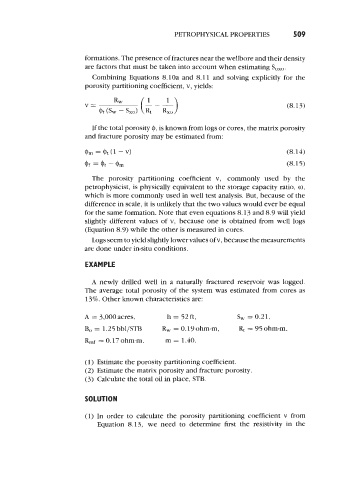
                             Combining Equations 8.10a and 8.11 and solving explicitly for the
                           porosity partitioning coefficient, v, yields:


                                                                                        (8.13)


                             If the total porosity $, is known from logs or cores, the matrix porosity
                           and fracture porosity may be estimated from:

                           Om = cpt  (1 - v)                                            (8.14)

                           Of = Ot - Om                                                 (8.15)
                             The  porosity  partitioning  coefficient  v,  commonly  used  by  the
                           petrophysicist, is physically equivalent to the storage capacity ratio, o,
                           which is more commonly used in well test analysis. But, because of the
                           difference in scale, it is unlikely that the two values would ever be equal
                           for the same formation. Note that even equations 8.13 and 8.9 will yield
                           slightly different values of  v, because  one is obtained from well logs
                           (Equation 8.9) while the other is measured in cores.
                             Logs seem to yield slightly lower values of v, because the measurements
                           are done under in-situ conditions.

                           EXAMPLE

                             A  newly drilled well  in  a naturally fractured  reservoir was  logged.
                           The average total porosity of  the system was estimated from cores as
                           13%. Other known characteristics are:

                           A  = 3,00Oacres,         h = 52ft,            s,  = 0.21,
                           Bo  = 1.25 bbl/STB     R,   = 0.19 ohm-m,     Rt = 95ohm-m,
                           Rd = 0.17 ohm-m,        m = 1.40.


                           (1)  Estimate the porosity partitioning coefficient.
                           (2)  Estimate the matrix porosity and fracture porosity.
                           (3)  Calculate the total oil in place, STB.

                           SOLUTION


                           (1)  In  order  to  calculate the  porosity partitioning coefficient v  from
                              Equation  8.13,  we  need  to  determine  first  the  resistivity in  the

