


Page 538 - Petrophysics
P. 538
PETROPHYSICAL PROPERTIES            505


                           is  equal to  unity.  In  this  case  the formation resistivity factor can be
                           expressed as:


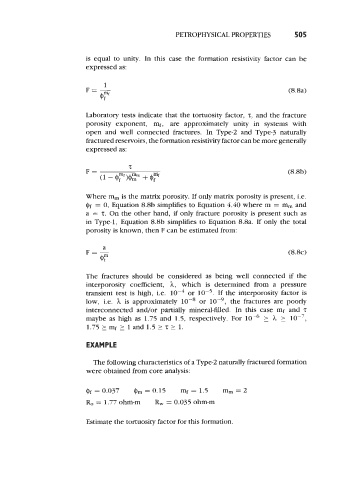
                                                                                        (8.8a)


                           Laboratory tests indicate that the tortuosity factor, T, and the fracture
                           porosity  exponent,  mf,  are  approximately  unity  in  systems  with
                           open  and  well  connected  fractures.  In  Type-2 and  Type-3 naturally
                           fractured reservoirs, the formation resistivity factor can be more generally
                           expressed as:


                                                                                        (8.8b)


                           Where mm is the matrix porosity. If only matrix porosity is present, i.e.
                           $f  = 0, Equation 8.8b simplifies to Equation 4.40 where m = mm and
                           a  = T. On the other hand, if only fracture porosity is present such as
                           in Type-1, Equation 8.8b simplifies to Equation 8.8a. If  only the total
                           porosity is known, then F can be estimated from:


                                                                                        (8.8~)


                           The  fractures should  be  considered  as  being  well  connected  if  the
                           interporosity  coefficient,  h,  which  is  determined  from  a  pressure
                           transient test is high, i.e.  lo-*  or  lop5. If  the interporosity factor is
                           low,  i.e.  h is approximately  lows or  loT9, the  fractures  are poorly
                           interconnected  and/or  partially  mineral-filled.  In  this  case  mf  and  T
                           maybe  as high as  1.75 and  1.5, respectively. For   3 h  2 lo-',
                           1.75 > mf > 1 and 1.5 3 T 3 1.

                           EXAMPLE


                             The following characteristics of a Type-2 naturally fractured formation
                           were obtained from core analysis:


                           $f = 0.037    $m  = 0.15    mf = 1.5     mm  = 2
                           R, = 1.77 ohm-m      Rw = 0.035 ohm-m


                           Estimate the tortuosity factor for this formation.

