


Page 588 - Petrophysics
P. 588
STATIC STRESS-STRAIN RELATION           555


                                                                 -.
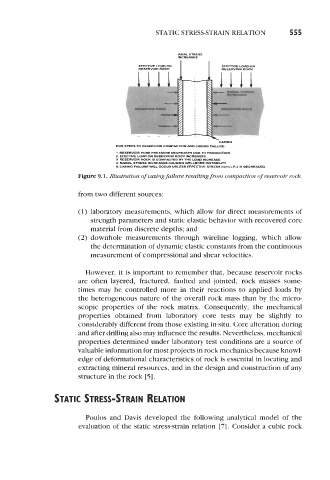
                                                                   CASINO
                                    RVE SRPS To REsEIIW3lR -ACTION   N40 CASINO FAJLURE:
                                    1. RL~LRVOIR FWRE PRESSURE DCCREAS=  WE m mowcnow.
                                    2 EPECTMT LOM ON RESER-   ROCK WJCRWES.
                                    a RESERVOIR  ROCK IS COMPACIZD   BY THE wm INCRME.
                                    4.  RADIAL STRESS INCREASES CMSINQ WEUORE INST#EIuTy.
                                    6. CASING FAILURE WILL OCCUR UNLESS EFRCTIM STRESS  (-e)   IS DECREASED.
                        Figure 9.1. Illustration of casing failure resulting from compaction of reservoir rock.

                        from two different sources:

                         (1) laboratory measurements, which allow for direct measurements of
                            strength parameters and static elastic behavior with recovered core
                            material from discrete depths; and
                         (2)  downhole  measurements through wireline  logging,  which  allow
                            the determination of dynamic elastic constants from the continuous
                            measurement of compressional and shear velocities.

                           However, it is important to remember that, because reservoir rocks
                         are often layered,  fractured, faulted  and jointed,  rock  masses  some-
                         times may  be  controlled more in their reactions to applied loads by
                         the heterogeneous nature of  the overall rock mass than by the micro-
                         scopic properties of  the  rock  matrix.  Consequently, the  mechanical
                         properties  obtained  from  laboratory  core  tests  may  be  slightly  to
                         considerably different from those existing in-situ. Core alteration during
                         and after drilling also may influence the results. Nevertheless, mechanical
                         properties determined under laboratory test conditions are a source of
                        valuable information for most projects in rock mechanics because knowl-
                         edge of deformational characteristics of rock is essential in locating and
                         extracting mineral resources, and in the design and construction of any
                         structure in the rock [5].

                  STATIC STRESS~TRAIN RELATION


                           Poulos and Davis  developed the following analytical model  of  the
                         evaluation of  the static stress-strain relation [7]. Consider a cubic rock

