


Page 592 - Petrophysics
P. 592
STATIC STRESS-STRAIN RELATION           559


                            If the magnitudes and directions of  the principal stresses can be easily
                            obtained, it is convenient to use them as reference axes.

                     STRAIN ANALYSIS


                              Strain is defined as the compression (positive) or extension (negative)
                            resulting from the application of external forces, divided by the original
                            dimension. Two types of  strain can be recognized: homogeneous and
                            heterogeneous. When every part of a body is subjected to a strain of the
                            same type and magnitude in any direction of the displacement, the strain
                            is considered homogeneous [7]. The strain is heterogeneous if it is not the
                            same throughout the body. Strain resulting from extended application of
                            large stresses at high temperatures is described as finite. If,  however,
                            the strain results from the application of an increment of stress and can
                            be treated mathematically, then it is defined as infinitesimal strain. The
                            strain is responsible for inducing body displacement, rotation, and strain.
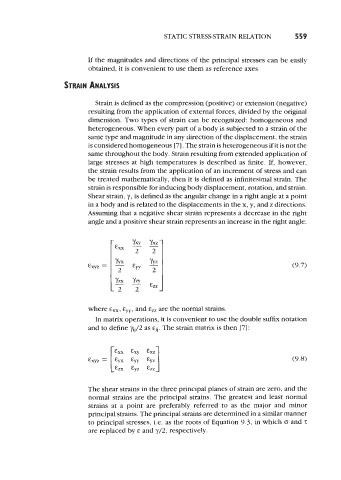
                            Shear strain, y, is defined as the angular change in a right angle at a point
                            in a body and is related to the displacements in the x, y, and z directions.
                            Assuming that a negative shear strain represents a decrease in the right
                            angle and a positive shear strain represents an increase in the right angle:


                                            ,
                            where E=,  E  ~ and   are the normal strains.
                              In matrix operations, it is convenient to use the double suffix notation
                            and to define yij/2  as Eij. The strain matrix is then [7]:


                                                                                          (9.8)


                            The shear strains in the three principal planes of strain are zero, and the
                            normal strains are the principal strains. The greatest and least normal
                            strains at  a  point  are preferably referred  to as the  major and  minor
                            principal strains. The principal strains  are determined in a similar manner
                            to principal stresses, i.e. as the roots of Equation 9.3, in which 0 and 7
                            are replaced by E and y/2,  respectively.

