


Page 595 - Petrophysics
P. 595
562    PETROPHYSICS: RESERVOIR ROCK PROPERTIES


                    parameters to accurately simulate the in-situ condition. Three measuring
                    and loading techniques are commonly used: hydrostatic, uniaxial, and
                    triaxial. These techniques, which are discussed later, essentially involve
                    applying  a  specified  load  and  measuring  the  corresponding  strain
                    according to the theory of linear elasticity.

             HOOKE’S LAW


                      If a rock body is subjected to directed forces lasting for a few minutes,
                    hours,  or  days,  it usually passes through four stages of  deformation:
                    elastic, elastico-viscous, plastic, and rupture. The stages are dependent
                    upon the elasticity, viscosity, and rigidity of the rock, as well as on its
                    stress history, temperature, time, pore pressure, and anisotropy.
                      At first, the deformation is elastic-that  is, if the stress is withdrawn,
                    the  body  returns  to  its  original  shape  and  size.  With  purely  elastic
                    deformation, the strain is a linear function of stress, i.e.,  the material
                    obeys Hooke’s law, as shown in Figure 9.6.

                    CJ  = EE                                                     (9.19)
                    where E is the modulus of elasticity. E, which is also known as Young’s
                    modulus, is a measure of the property of the rock to resist deformation.
                    If a cylindrical rock sample is subjected to stress parallel to its long axis,
                    it will lengthen and the diameter of the cylinder becomes smaller under
                    tension as shown in Figure 9.7. Under compression parallel to the axis,
                    the rock sample wiII shorten while its diameter becomes greater. The
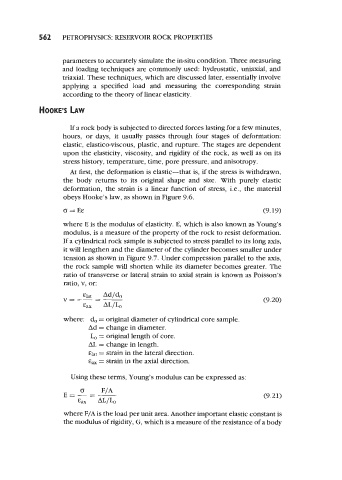
                    ratio of transverse or lateral strain to axial strain is known as Poisson’s
                    ratio, v, or:

                                                                                 (9.20)


                    where:  do  = original diameter of cylindrical core sample.
                            Ad = change in diameter.
                             Lo = original length of core.
                            AL = change in length.
                            Elat = strain in the lateral direction.
                               = strain in the axial direction.

                       Using these terms, Young’s modulus can be expressed as:

                          <T
                     E=--  -    F/A                                               (9.21)
                         Eax   AL/L
                     where F/A is the load per unit area. Another important elastic constant is
                     the modulus of rigidity, G, which is a measure of the resistance of a body

