


Page 247 - Contribution To Phenomenology
P. 247
240        STANFORD     M  LYMAN & LESTER      EMBREE

              members  of  one  group  might  be  bothered  by  the  gestures,  e.g.,  the
              flamboyant  hand  movements,  of  members  of  another  group,  while  the
              others  are  bothered  by  the  posture,  e.g.,  the  stiff  necks,  of  the  first
              group, and these  cultural encounters, as we  might call  them,  involve  types
              of  awareness  as  well  as  types  of  positionality  and  are  analyzable  in  terms
              of  these  types.


              (Figure  1)
                                                    Noema    Noesis

              I.  Awareness
                A.  Presentational  Awareness
                      1.  Perceptual
                      2.  Memorial
                      3.  Expectational
                      4.  Etc.
               B.  Representational  Awareness
                      1.  Indicational
                      2.  Pictorial
                      3.  Linguistic
              II.  Positionality
                      1.  Belief
                      2.  Evaluation
                      3.  Willing


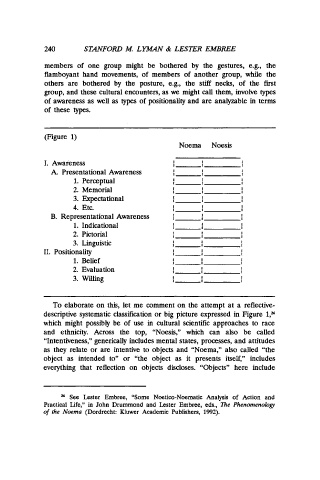
                To  elaborate  on  this,  let  me  comment  on  the  attempt  at  a  reflective-
             descriptive  systematic  classification  or  big  picture  expressed  in  Figure  1,^
             which  might  possibly  be  of  use  in  cultural  scientific  approaches  to  race
             and  ethnicity.  Across  the  top,  "Noesis,"  which  can  also  be  called
              "Intentiveness," generically  includes mental states,  processes,  and attitudes
             as  they  relate  or  are  intentive  to  objects  and  "Noema,"  also  called  "the
             object  as  intended  to"  or  "the  object  as  it  presents  itself,"  includes
             everything  that  reflection  on  objects  discloses.  "Objects"  here  include


                  ^  See  Lester  Embree,  "Some  Noetico-Noematic  Analysis  of  Action  and
              Practical  Life,"  in  John  Drummond  and  Lester  Embree,  eds.,  The Phenomenology
             of  the  Noema  (Dordrecht:  Kluwer  Academic  Publishers,  1992).

