


Page 124 - Photoreactive Organic Thin Films
P. 124
3, PHOTO-ORIENTATION BY PHOTOISOMERIZATION

                                               1
                                              /""  /  \                      / "2 "O /" *
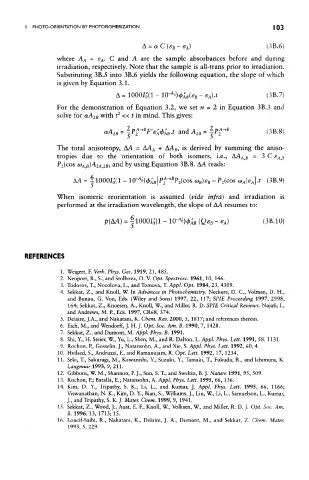
                                        A = (X L/ (£jj —        ff^.)        \JJD.D)
               where A A = e A. C and A are the sample absorbances before and during
               irradiation, respectively. Note that the sample is all-trans prior to irradiation.
               Substituting 3B.5 into 3B.6 yields the following equation, the slope of which
               is given by Equation 3.1.
                                                A
                                 A = 100010(1 - l(r °')<£; B(£ B - e A}.t    (3B.7)
               For the demonstration of Equation 3.2, we set n - 2 in Equation 3B.3 and
                                 2
               solve for oA 2B with t  « t in mind. This gives:

                                28    2     A AB        2B    2
                                  5             '         5
               The total anisotropy, AA = AA A + AA B, is derived by summing the aniso-
               tropies due to the orientation of both isomers, i.e., AA A)B = 3 C e A$
               P 2{cos w AjB)A 2A)2B, and by using Equation 3B.8. AA reads:
                                        A
                                               A
                                                  B
                    AA = f 1000/ 0'(1 - 10~ o)<^ B{P -* P 2(cos a) B)e B - P 2(cos <*) A)s A}.t (3B.9)
                         5
               When isomeric reorientation is assumed (vide infra,} and irradiation is
               performed at the irradiation wavelength, the slope of AA resumes to:
                                                   A
                             p(AA) = |lOOO/ 0'd - IO- O)^ B (Q% - *A)       (3B.10)


                1. Weigert, F. Verb. Phys. Ges. 1919, 21, 485.
                2. Neoport, B., S., and Stolbova, O. V. Opt. Spectrosc. 1961, 10, 146.
                3. Todorov, T., Nocolova, L., and Tomova, T. Appl. Opt. 1984, 23, 4309.
                4. Sekkat, Z., and Knoll, W. In Advances in Photochemistry. Neckers, D. C., Volman, D. H.,
                  and Bunau, G. Von, Eds. (Wiley and Sons) 1997, 22, 117; SPIE Proceeding 1997, 2998,
                  164; Sekkat, Z., Knoesen, A., Knoll, W., and Miller, R. D. SPIE Critical Reviews. Najafi, I.,
                  and Andrews, M. P., Eds. 1997, CR68, 374.
                5. Delaire, J.A., and Nakatani, K. Chem. Rev. 2000, 5, 1817; and references therein.
                6. Eich, M., and Wendorff, J. H. /. Opt. Soc. Am. B. 1990, 7,1428.
                7. Sekkat, Z., and Dumont, M. Appl. Phys. B. 1991.
                8. Shi, Y., H. Steier, W., Yu, L., Shen, M., and R. Dalton, L. Appl. Phys. Lett. 1991, 58, 1131.
                9. Rochon, P., Gosselin, J., Natansohn, A., and Xie, S. Appl. Phys. Lett. 1992, 60, 4.
               10. Hvilsed, S., Andruzzi, E, and Ramanujam, R. Opt. Lett. 1992, 17, 1234.
               11. Seki, T., Sakuragi, M., Kawanishi, Y., Suzuki, Y., Tamaki, T., Fukuda, R., and Ichimura, K.
                  Langmuirl993, 9, 211.
               12. Gibbons, W. M., Shannon, P. J., Sun, S. T., and Sweltin, B. J. Nature 1991, 95, 509.
               13. Rochon, P.; Batalla, E.; Natansohn, A. Appl. Phys. Lett. 1995, 66, 136.
                14. Kim, D. Y., Tripathy, S. K., Li, L., and Kumar, J. Appl. Phys. Lett. 1995, 66, 1166;
                  Viswanathan, N. K., Kim, D. Y., Bian, S., Williams, J., Liu, W, Li, L., Samuelson, L., Kumar,
                  J., and Tripathy, S. K. /. Mater. Chem. 1999, 9, 1941.
               15. Sekkat, Z., Wood, J., Aust, E. E, Knoll, W, Volksen, W, and Miller, R. D, /. Opt. Soc. Am.
                  B. 1996, 13, 1713; 15.
               16. Loucif-Saibi, R., Nakatani, K., Delaire, J. A., Dumont, M., and Sekkat, Z. Chem. Mater.
                  1993, 5, 229.

