


Page 120 - Photoreactive Organic Thin Films
P. 120
3  PHOTO-ORIENTATION BY PHOTOISOMERIZATION                                 99

               extinction coefficient of the trans (respectively cis) isomer, <f> t' c (respectively
               <f>ct) the quantum yield of the trans-»cis (respectively cis— >trans) photo-
               isomerization, and c t the concentration of the trans isomers. IQ, is the
               intensity of the irradiating light (flux of photons per square centimeter), and
                                                                             2
               the factor 1000 occurs when / 0' is expressed in mol of photon/cm . The
               extinction coefficients (proportional to the cross section) and the concen-
                                                             1
                                                 1
                                            1
               trations are expressed in L.mol~ .cm~  and mol.LT , respectively. Equation
               3 A.I can be rewritten as:
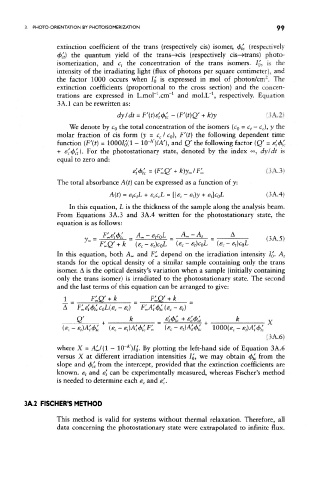
                                 dyldt = F'(t)e' t<f> t' c - (F'(t)Q' + k)y  (3A.2)
                   We denote by c 0 the total concentration of the isomers (CQ = c t - c c), y the
               molar fraction of cis form (y - c cl c 0), F'(t] the following dependent time
                                          A                                f
               function (F'(t) = 1000/ 0'(1 - W~ ')/A'), and Q' the following factor (Q  = s t& c
               + Sc<f>c t). For the photostationary state, denoted by the index °°, dyldt is
               equal to zero and:
                                                f
                                     e't&c = (F'M  + k)yj F:                 (3A.3)
               The total absorbance A(i) can be expressed as a function of y:
                               A(t) = e tc tL + s cc cL = [(e c - e t)y + e t]c QL  (3A.4)

                   In this equation, L is the thickness of the sample along the analysis beam.
               From Equations 3A.3 and 3A.4 written for the photostationary state, the
               equation is as follows:
                          = F'^fa   = A,-qcoL = A^-A t            A
                       /c
                        * FLQ' + k    (e c-s t}c QL  (s c-e t}c QL  (e c~e t)c QL
               In this equation, both A«, and F'l depend on the irradiation intensity IQ. A t
               stands for the optical density of a similar sample containing only the trans
               isomer. A is the optical density's variation when a sample (initially containing
               only the trans isomer) is irradiated to the photostationary state. The second
               and the last terms of this equation can be arranged to give:
                 i       F:' + k           F;' + k
                 A   FLe'tfa c,Le - e   F'     (e - e
                     Q'
                 s c-e tt<     e c -e tt c      e c- e tt<
                                                                             (3A.6)
                                    A
               where X = A'J(l - 10- ')/o- By plotting the left-hand side of Equation 3A.6
                                                                         f
               versus X at different irradiation intensities I 0', we may obtain  <j> tc from the
               slope and dj>' ct from the intercept, provided that the extinction coefficients are
               known. s t and s' t can be experimentally measured, whereas Fischer's method
               is needed to determine each e c and e' c.


      3A.2 FISCHER'S METHOD

               This method is valid for systems without thermal relaxation. Therefore, all
               data concerning the photostationary state were extrapolated to infinite flux.

