


Page 117 - Photoreactive Organic Thin Films
P. 117
ZOUHEIR SEKKAT

                 A<h-B isomerization and that the observed anisotropy at both 532 and
                 365 nm is due to the orientation of isomer B only. If orientation occurs in A
                 at any time by green irradiation, some anisotropy should remain at 365 nm
                 after all B are isomerized to A. This behavior is theoretically rationalized by
                      B
                 p^365~* 532 _ o, because the orientation of A is proportional to that of B
                           365  532
                 through P^ "^  (vide infra).
                     The lack of orientation in A may be due to the large amount of energy
                 that needs to be dissipated during the photochemical process induced by the
                 532 or 546 nm photon; perhaps when the molecule is excited, it shakes
                 strongly before it relaxes, wjff = 74.3 and 6/532 = 61.3 degrees demonstrate
                 that the direction of the UV, i.e., 365 and 405 nm, and visible, i.e., 532 nm,
                 transitions of the B isomer {the closed form) are oriented toward perpen-
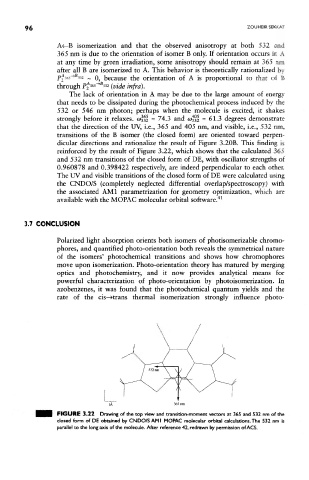
                 dicular directions and rationalize the result of Figure 3.20B. This finding is
                 reinforced by the result of Figure 3.22, which shows that the calculated 365
                 and 532 nm transitions of the closed form of DE, with oscillator strengths of
                 0.960878 and 0.398422 respectively, are indeed perpendicular to each other.
                 The UV and visible transitions of the closed form of DE were calculated using
                 the CNDO/S (completely neglected differential overlap/spectroscopy) with
                 the associated AMI parametrization for geometry optimization, which are
                 available with the MOPAC molecular orbital software. 41


        3.7 CONCLUSION

                 Polarized light absorption orients both isomers of photisomerizable chromo-
                 phores, and quantified photo-orientation both reveals the symmetrical nature
                 of the isomers' photochemical transitions and shows how chromophores
                 move upon isomerization. Photo-orientation theory has matured by merging
                 optics and photochemistry, and it now provides analytical means for
                 powerful characterization of photo-orientation by photoisomerization. In
                 azobenzenes, it was found that the photochemical quantum yields and the
                 rate of the cis—»trans thermal isomerization strongly influence photo-


                                 iA
                 FIGURE 3.22  Drawing of the top view and transition-moment vectors at 365 and 532 nm of the
                 closed form of DE obtained by CNDO/S AM I MOB^C molecular orbital calculations. The 532 nm is
                 parallel to the long axis of the molecule. After reference 42, redrawn by permission of ACS.

