


Page 121 - Photoreactive Organic Thin Films
P. 121
ZGUHEiR SEKKAT

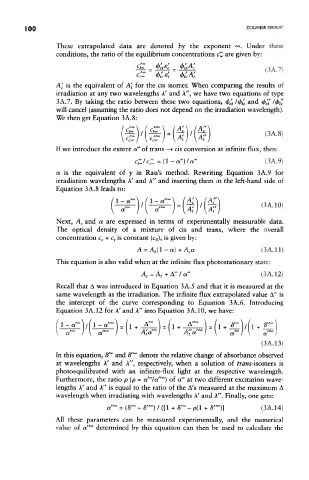
                 These extrapolated data are denoted by the exponent  <*>. Under these
                 conditions, the ratio of the equilibrium concentrations cZ are given by;
                                        C _______ _
                                                 s
                                         t<*>  4>ct c  $<;! Ac
                 A' c is the equivalent of A' t for the cis isorner. When comparing the results of
                 irradiation at any two wavelengths A' and A", we have two equations of type
                 3 A. 7. By taking the ratio between these two equations,  <f>^ l$l c and tf>#  /<f> t"
                 will cancel (assuming the ratio does not depend on the irradiation wavelength),
                 We then get Equation 3 A. 8:

                                                                              ,, A8 ,

                 If we introduce the extent a°° of trans — » cis conversion at infinite flux, then:
                                        <£/<£= (l-a")/a-                      (3A.9)
                 a is the equivalent of y in Rau's method. Rewriting Equation 3 A. 9 for
                 irradiation wavelengths A' and A" and inserting them in the left-hand side of
                 Equation 3 A. 8 leads to:

                                      AX, \ / 1  //«, \  / A'\ / A"\
                                                                             (3A.10)

                 Next, A c and a are expressed in terms of experimentally measurable data.
                The optical density of a mixture of cis and trans, where the overall
                 concentration c c + c t is constant (c 0), is given by:

                                        A = A t(l - a) + A ca                 (3A.ll)
                This equation is also valid when at the infinite flux photostationary state:
                                                   00
                                          A c = A t + A  / oT                (3A.12)
                Recall that A was introduced in Equation 3 A. 5 and that it is measured at the
                                                                                 00
                same wavelength as the irradiation. The infinite flux extrapolated value A  is
                the intercept of the curve corresponding to Equation 3A.6. Introducing
                Equation 3A.12 for A' and A" into Equation 3A.10, we have:


                                                                             (3A.13)
                In this equation, 8°° and 5"°° denote the relative change of absorbance observed
                at wavelengths A' and A", respectively, when a solution of Zraws-isomers is
                photoequilibrated with an infinite-flux light at the respective wavelength.
                                               m
                Furthermore, the ratio p (p - a°°la" } of a°° at two different excitation wave-
                lengths A' and A" is equal to the ratio of the A's measured at the maximum A
                wavelength when irradiating with wavelengths A' and X". Finally, one gets:
                               a"- = (8'~- 8"-) I ([I + 5"" - p(l + S"~)]    (3A.14)
                All these parameters can be measured experimentally, and the numerical
                value of a"°° determined by this equation can then be used to calculate the

