


Page 115 - Photoreactive Organic Thin Films
P. 115
94                                                               ZOUHEIR SEKKAT


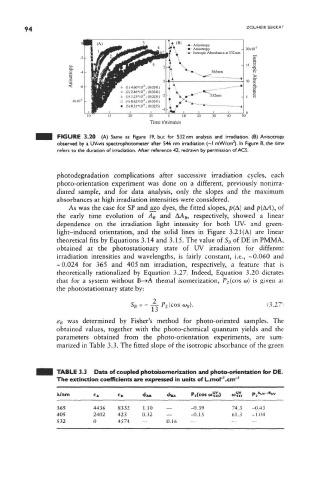
                 FIGURE 3.20 (A) Same as Figure 19, but for 532 nm analysis and irradiation, (B) Anisotropy
                                                                     2
                 observed by a UV-vis spectrophotometer after 546 nm irradiation (~l mW/cm ). In Figure B, the time
                 refers to the duration of irradiation. After reference 42, redrawn by permission of ACS.


                 photodegradation complications after successive irradiation cycles, each
                 photo-orientation experiment was done on a different, previously nonirra-
                 diated sample, and for data analysis, only the slopes and the maximum
                 absorbances at high irradiation intensities were considered.
                     As was the case for SP andazo dyes, the fitted slopes, p(A) and p(AA), of
                 the early time evolution of A B and AA B, respectively, showed a linear
                 dependence on the irradiation light intensity for both UV- and green-
                 light-induced orientation, and the solid lines in Figure 3.21 (A) are linear
                 theoretical fits by Equations 3.14 and 3.15. The value of S B of DE in PMMA,
                 obtained at the photostationary state of UV irradiation for different
                 irradiation intensities and wavelengths, is fairly constant, i.e., -0.060 and
                 ~ 0.024 for 365 and 405 nm irradiation, respectively, a feature that is
                 theoretically rationalized by Equation 3.27. Indeed, Equation 3.20 dictates
                 that for a system without B—>A themal isomerization, F 2(cos to) is given at
                 the photostationnary state by:

                                       S B = -~P 2 (cos6> B ).                  (3.27}

                 % was determined by Fisher's method for photo-oriented samples. The
                 obtained values, together with the photo-chemical quantum yields and the
                 parameters obtained from the photo-orientation experiments, are sum-
                 marized in Table 3.3. The fitted slope of the isotropic absorbance of the green


                 TABLE 3.3 Data of coupled photoisomerization and photo-orientation for DE.
                 The extinction coefficients are expressed in units of L.mor'.cm" 1


                 X/nm       e A    e B     <£ AB  <£ BA  P 2(cos 01^2)  «Sa
                 365        4436   8332    1.10   —      -0.39       74.3 -0.43
                 405        2402   423    0.32    —      -0.15       61.3 -1.04
                 532        0      4574   —       0.16   —           —

