


Page 167 - Photoreactive Organic Thin Films
P. 167
MIKHAIL V. KOZLOVSKY, LEV M. BLINOV, AND WOLFGANG HAASE

                                                  X < 400 nm


                                                 X > 400 nm, /, A
                        U-form (or trans-isomsr)            Z-form (or cw-isomer)

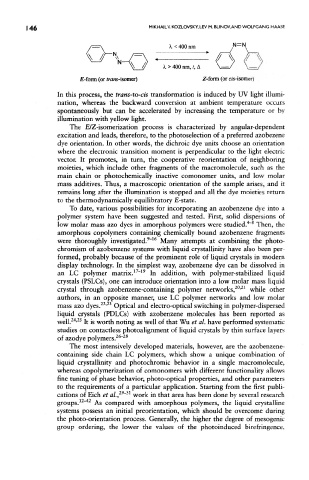
                 In this process, the trans-to-cis transformation is induced by UV light illumi-
                 nation, whereas the backward conversion at ambient temperature occurs
                 spontaneously but can be accelerated by increasing the temperature or by
                 illumination with yellow light.
                     The E/Z-isomerization process is characterized by angular-dependent
                 excitation and leads, therefore, to the photoselection of a preferred azobezene
                 dye orientation. In other words, the dichroic dye units choose an orientation
                 where the electronic transition moment is perpendicular to the light electric
                 vector. It promotes, in turn, the cooperative reorientation of neighboring
                 moieties, which include other fragments of the macromolecule, such as the
                 main chain or photochemically inactive comonomer units, and low molar
                 mass additives. Thus, a macroscopic orientation of the sample arises, and it
                 remains long after the illumination is stopped and all the dye moieties return
                 to the thermodynamically equilibratory E-state.
                     To date, various possibilities for incorporating an azobenzene dye into a
                 polymer system have been suggested and tested. First, solid dispersions of
                                                                         4 8
                 low molar mass azo dyes in amorphous polymers were studied. "  Then, the
                 amorphous copolymers containing chemically bound azobenzene fragments
                                             16
                                           9
                 were thoroughly investigated. ""  Many attempts at combining the photo-
                 chromism of azobenzene systems with liquid crystallinity have also been per-
                 formed, probably because of the prominent role of liquid crystals in modern
                 display technology. In the simplest way, azobenzene dye can be dissolved in
                                        17 19
                 an LC polymer matrix. "  In addition, with polymer-stabilized liquid
                 crystals (PSLCs), one can introduce orientation into a low molar mass liquid
                                                                      20 21
                 crystal through azobenzene-containing polymer networks, '  while other
                 authors, in an opposite manner, use LC polymer networks and low molar
                              22 23
                 mass azo dyes. '  Optical and electro-optical switching in polymer-dispersed
                 liquid crystals (PDLCs) with azobenzene molecules has been reported as
                     24 25
                 well. '  It is worth noting as well of that Wu et al, have performed systematic
                 studies on contactless photoalignment of liquid crystals by thin surface layers
                                  26
                 of azodye polymers. "" 28
                     The most intensively developed materials, however, are the azobenzene-
                 containing side chain LC polymers, which show a unique combination of
                 liquid crystallinity and photochromic behavior in a single macromolecule,
                 whereas copolymerization of comonomers with different functionality allows
                 fine tuning of phase behavior, photo-optical properties, and other parameters
                 to the requirements of a particular application. Starting from the first publi-
                                   29 31
                 cations of Eich et #/., ~  work in that area has been done by several research
                        32 42
                 groups. '  As compared with amorphous polymers, the liquid crystalline
                 systems possess an initial preorientation, which should be overcome during
                 the photo-orientation process. Generally, the higher the degree of mesogenic
                 group ordering, the lower the values of the photoinduced birefringence,

