


Page 171 - Photoreactive Organic Thin Films
P. 171
MIKHAIL V KOZLOVSKY, LEV M. BLINOV, AND WOLFGANG HAASE


                                                                  ±
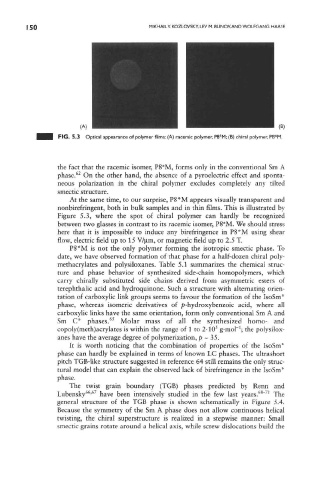
                  FIG. 5.3  Optical appearance of polymer films: (A) racemic polymer, P8 M; (B) chira! polymer, P8*M,


                  the fact that the racemic isomer, P8*M, forms only in the conventional Sm A
                       62
                  phase.  On the other hand, the absence of a pyroelectric effect and sponta-
                  neous polarization in the chiral polymer excludes completely any tilted
                  smectic structure.
                     At the same time, to our surprise, P8*M appears visually transparent and
                  nonbirefringent, both in bulk samples and in thin films. This is illustrated by
                  Figure 5.3, where the spot of chiral polymer can hardly be recognized
                  between two glasses in contrast to its racemic isomer, P8*M, We should stress
                  here that it is impossible to induce any birefringence in P8*M using shear
                  flow, electric field up to 15 V/um, or magnetic field up to 2.5 T.
                     P8*M is not the only polymer forming the isotropic smectic phase. To
                  date, we have observed formation of that phase for a half-dozen chiral poly-
                  methacrylates and polysiloxanes. Table 5.1 summarizes the chemical struc-
                  ture and phase behavior of synthesized side-chain homopolymers, which
                  carry chirally substituted side chains derived from asymmetric esters of
                  terephthalic acid and hydroquinone. Such a structure with alternating orien-
                  tation of carboxylic link groups seems to favour the formation of the IsoSm*
                  phase, whereas isomeric derivatives of /7-hydroxybenzoic acid, where all
                  carboxylic links have the same orientation, form only conventional Sm A and
                                 65
                  Sm C* phases.  Molar mass of all the synthesized homo- and
                                                                       1
                                                                5
                  copoly(meth)acrylates is within the range of 1 to 2-10  g-mol" ; the polysilox-
                  anes have the average degree of polymerization, p ~ 35.
                     It is worth noticing that the combination of properties of the IsoSrn*
                  phase can hardly be explained in terms of known LC phases. The ultrashort
                  pitch TGB-like structure suggested in reference 64 still remains the only struc-
                  tural model that can explain the observed lack of birefringence in the IsoSm*
                  phase.
                     The twist grain boundary (TGB) phases predicted by Renn and
                          66 67
                                                                            68
                                                                               71
                  Lubensky '  have been intensively studied in the few last years. ""  The
                  general structure of the TGB phase is shown schematically in Figure 5.4.
                  Because the symmetry of the Sm A phase does not allow continuous helical
                  twisting, the chiral superstructure is realized in a step wise manner: Small
                  smectic grains rotate around a helical axis, while screw dislocations build the

