


Page 175 - Photoreactive Organic Thin Films
P. 175
154                                 MIKHAIL V. KOZLOVSKY, LEV M. BLINOV, AND WOLFGANG HAASE


                                                  2,5
                                                  2,0
                                               <D
                                               | 1,5
                                              •e
                                              I ''°
                                                  0,5


               200    300    400    500    600     300       400        500       600
        (A)           Wavelength, X, nm                      Wavelength, X, nm     (B)
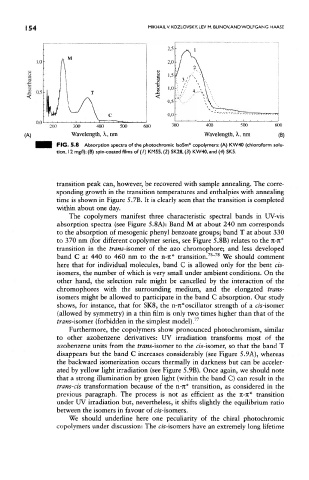
                 FIG. 5.8 Absorption spectra of the photochromic IsoSm* copolymers: (A) KW40 (chloroform solu-
                 tion, 1 2 mg/l); (B) spin-coated films of ( /) KM55, (2) SK28, (3) KW40, and (4) SK5.


                 transition peak can, however, be recovered with sample annealing. The corre-
                 sponding growth in the transition temperatures and enthalpies with annealing
                 time is shown in Figure 5.7B. It is clearly seen that the transition is completed
                 within about one day.
                     The copolymers manifest three characteristic spectral bands in UV-vis
                 absorption spectra (see Figure 5.8A): Band M at about 240 nm corresponds
                 to the absorption of mesogenic phenyl benzoate groups; band T at about 330
                 to 370 nm (for different copolymer series, see Figure 5.8B) relates to the n~n*
                 transition in the trans-isomer of the azo chromophore; and less developed
                                                              76 78
                 band C at 440 to 460 nm to the n-rc* transition. '  We should comment
                 here that for individual molecules, band C is allowed only for the bent cis-
                 isomers, the number of which is very small under ambient conditions. On the
                 other hand, the selection rule might be cancelled by the interaction of the
                 chromophores with the surrounding medium, and the elongated trans-
                 isomers might be allowed to participate in the band C absorption. Our study
                 shows, for instance, that for SK8, the n-n*oscillator strength of a o's-isorner
                 (allowed by symmetry) in a thin film is only two times higher than that of the
                 £ra«s-isomer (forbidden in the simplest model). 77
                     Furthermore, the copolymers show pronounced photochromism, similar
                 to other azobenzene derivatives: UV irradiation transforms most of the
                 azobenzene units from the trans-isomer to the ds-isomer, so that the band T
                 disappears but the band C increases considerably (see Figure 5.9A), whereas
                 the backward isomerization occurs thermally in darkness but can be acceler-
                 ated by yellow light irradiation (see Figure 5.9B). Once again, we should note
                 that a strong illumination by green light (within the band C) can result in the
                 tran$-ds transformation because of the n-n* transition, as considered in the
                 previous paragraph. The process is not as efficient as the n-n* transition
                 under UV irradiation but, nevertheless, it shifts slightly the equilibrium ratio
                 between the isomers in favour of m-isomers.
                     We should underline here one peculiarity of the chiral photochromic
                 copolymers under discussion: The cis-isomets have an extremely long lifetime

