


Page 177 - Photoreactive Organic Thin Films
P. 177
J §£                                MIKHAIL V. KOZLOVSKY, LEV M BLINOV, AND WOLFGANG HAASE


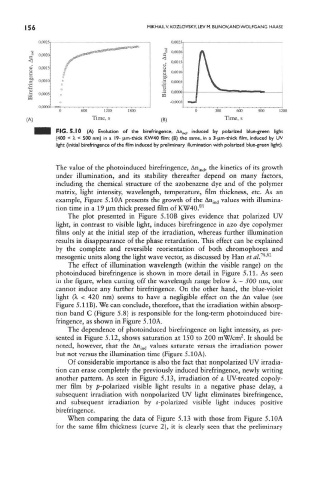
                 FIG. 5.10 (A) Evolution of the birefringence, An ind, induced by polarized blue-green light
                 (400 < X < 500 nm) in a 19- (inn-thick KW40 film; (B) the same, in a 3-fim-thick film, induced by UV
                 light (initial birefringence of the film induced by preliminary illumination with polarized blue-green light),


                 The value of the photoinduced birefringence, An ind, the kinetics of its growth
                 under illumination, and its stability thereafter depend on many factors,
                 including the chemical structure of the azobenzene dye and of the polymer
                 matrix, light intensity, wavelength, temperature, film thickness, etc. As an
                 example, Figure 5.10A presents the growth of the An ind values with illumina-
                 tion time in a 19 tim thick pressed film of KW40. 81
                     The plot presented in Figure 5.1 OB gives evidence that polarized UV
                 light, in contrast to visible light, induces birefringence in azo dye copolymer
                 films only at the initial step of the irradiation, whereas further illumination
                 results in disappearance of the phase retardation. This effect can be explained
                 by the complete and reversible reorientation of both chromophores and
                                                                              78 82
                 mesogenic units along the light wave vector, as discussed by Han et <a/. '
                     The effect of illumination wavelength (within the visible range) on the
                 photoinduced birefringence is shown in more detail in Figure 5.11. As seen
                 in the figure, when cutting off the wavelength range below A, ~ 500 nm, one
                 cannot induce any further birefringence. On the other hand, the blue-violet
                 light (X < 420 nm) seems to have a negligible effect on the An value (see
                 Figure 5.1 IB). We can conclude, therefore, that the irradiation within absorp-
                 tion band C (Figure 5.8) is responsible for the long-term photoinduced bire-
                 fringence, as shown in Figure 5.10A.
                     The dependence of photoinduced birefringence on light intensity, as pre-
                                                                        2
                 sented in Figure 5.12, shows saturation at 150 to 200 mW/cm . It should be
                 noted, however, that the An ind values saturate versus the irradiation power
                 but not versus the illumination time (Figure 5.10A).
                     Of considerable importance is also the fact that nonpolarized UV irradia-
                 tion can erase completely the previously induced birefringence, newly writing
                 another pattern. As seen in Figure 5.13, irradiation of a UV-treated copoly-
                 mer film by p-polarized visible light results in a negative phase delay, a
                 subsequent irradiation with nonpolarized UV light eliminates birefringence,
                 and subsequent irradiation by s-polarized visible light induces positive
                 birefringence.
                     When comparing the data of Figure 5.13 with those from Figure 5.10A
                 for the same film thickness (curve 2), it is clearly seen that the preliminary

